
| Resources
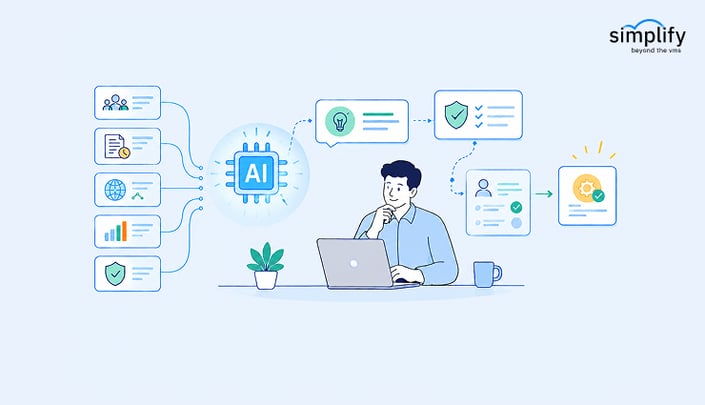
Modern Vendor Management Systems can analyze large volumes of workforce data, identify patterns and trends, highlight potential risks and opportunities, generate insights, support decision-making, and automate repetitive workflows.
But as AI becomes more involved in workforce management, an important question becomes increasingly relevant:
When AI recommends an action, who makes the final call?
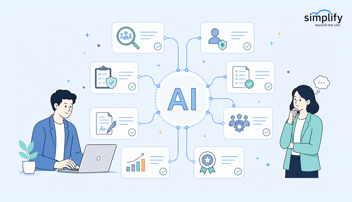
In an AI-native VMS, AI can provide recommendations, insights, alerts, and decision support. It can help users work with information faster and identify issues that may need attention. However, important business decisions still require human review, business context, and clear accountability.
The goal is not to choose between AI and people. The goal is to create a workflow where AI does more of the analysis, and people focus on decisions that require judgment.
This is the idea behind augmented intelligence in modern VMS platforms: technology supports people without removing the human role from important decisions.
AI vs. Human Decisions: Understanding the Difference
AI and people bring different strengths to a VMS workflow. AI can process large amounts of information quickly. It can compare records, identify patterns, generate recommendations, flag potential issues, and automate defined tasks.
People can review those recommendations, consider business circumstances, apply their experience, and decide what action should be taken.
This makes AI and human roles complementary: AI helps analyse information and provide recommendations, while people apply context and judgment to make decisions.
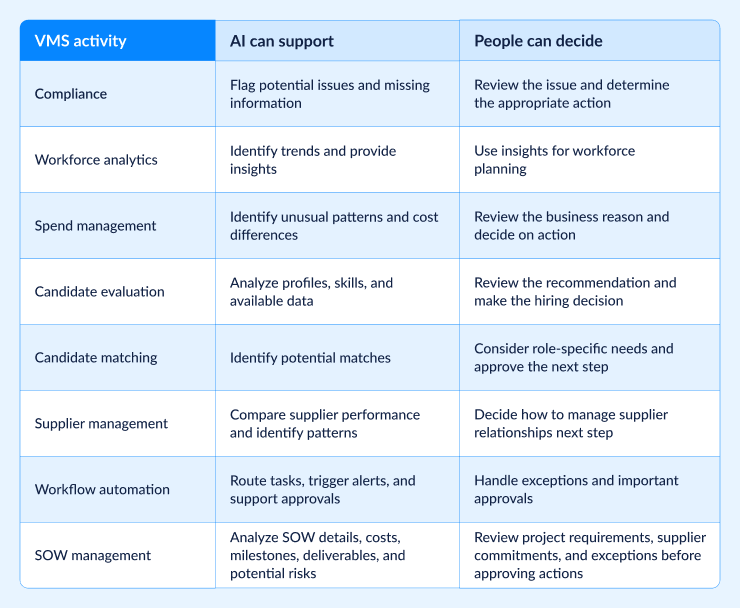
The exact level of automation can vary by workflow, risk, and organizational policy. But the basic principle remains the same: AI can support the decision process, while people remain responsible for decisions that require business judgment.
Where Can AI Recommend and Where People Decide?
The difference becomes easier to understand when we look at common VMS activities, such as candidate matching, compliance checks, financial review, and workflow automation. AI can analyse information, identify potential issues, and recommend actions, while people review it and decide what to do.
1. Candidate Matching and Evaluation
AI can help evaluate candidate information and identify potential matches based on available skills, experience, role requirements, and other relevant data.
For organizations managing large talent pools, this can reduce the time spent manually reviewing large numbers of profiles. SimplifyVMS provides AI/ML capabilities for candidate evaluation and decision support through its Hiring AI Hub and AI Agent Ecosystem.
But an AI recommendation is not the same as a final hiring decision. A hiring professional may also need to consider business needs, role requirements, and information gathered during the selection process.
AI can narrow the field and provide useful signals. The human professional can review those signals and make the appropriate decision.
2. Job Description and Content Generation
Creating job descriptions and other workforce content can take significant time. An AI model can help generate or improve content based on defined requirements. This can help teams create drafts faster and reduce repetitive writing work.
The VMS platform uses AI for areas such as job descriptions and content generation, helping teams create content based on defined role requirements.
The human role remains important because the final content should accurately reflect the position, required skills, and business needs. AI can provide a starting point, while a person can review, refine, and approve the final version.
3. Compliance and Worker Classification
Compliance is another area where AI can support decision-making. A VMS can use AI-assisted intelligence together with configurable rules to help identify information that may require attention.
An AI-first Vendor Management System combines AI-assisted intelligence with configurable, rule-based controls across areas such as worker classification, documentation, and tenure management.
For example, the system may identify a potential issue with worker information, documents, classification, or tenure. It can alert the right team so the issue can be reviewed.
An alert does not automatically mean that a compliance violation has occurred. The issue may have a valid explanation or may require additional information before a decision can be made. The team can check the information, understand the situation, and decide what action is needed.
AI helps identify potential issues, while people review them and make the final decision.
4. Identifying Unusual Activity and Financial Control
External workforce programs generate large amounts of financial data through timekeeping, expenses, invoices, rates, and other transactions. Managing and reviewing all this information manually can take significant time and make it harder to spot unusual transactions, especially in large programs.
Intelligent analysis can help identify unusual patterns or transactions that may need further review.
For example, a system may flag a transaction because it does not follow an expected pattern. That does not necessarily mean the transaction is incorrect, but the flag is a signal for review.
AI-powered VMS platforms use a controlled approach to identifying unusual activity, such as unexpected invoice amounts, unusual worker hours, rate differences, or duplicate transactions, and to managing financial data. This helps organizations find areas that may need attention. The system highlights potential issues, while people review the situation and decide what action is needed.
5. GenAI and LLMs: Making Information Easier to Use
Generative AI and large language models are changing how users access, understand, and work with workforce information in a VMS.
Instead of searching through multiple reports or reviewing large amounts of information manually, users can use natural language capabilities to find, summarize, and understand information more easily.
An AI-native VMS applies GenAI and LLM capabilities to make information easier to access, understand, and use across the platform.
These capabilities can support activities such as:
- Information summarization
- Natural language search
- Automated insights
- Conversational interaction
- Easier access to workforce information
For example, instead of manually reviewing several reports, a user may be able to ask a question in natural language and receive a summarized view of relevant information. The user can then review the information and decide what action is appropriate.
6. Workflow Automation and Human Review
Not every VMS task requires a person to make a decision from the beginning. Many processes involve repetitive actions such as sending requests to the right team, generating alerts, moving tasks through workflow steps, and sending requests for approval.
Automation can handle these tasks based on configured rules. Modern VMS provides configurable automation across operational workflows to reduce manual effort while keeping the right controls in place. Automation handles defined tasks, while people remain responsible for decisions that require judgment.
Automation can handle defined steps in a workflow without making the entire process automatic.
For example:
Request submitted → System checks the information → Request goes to the right person → User reviews → Approval or next action
AI and automation can speed up the process, while people remain involved when a review, approval, or business decision is needed.
How AI and People Work Together?
The future of AI-powered VMS platforms is not necessarily about replacing human decisionmakers with AI.
A more practical model is augmented intelligence, where AI and people work together. AI can handle the heavy analytical work, such as analyzing workforce data, identifying patterns, and recommending actions. People provide business context, evaluate what those patterns mean, and decide whether the recommended action makes sense.
An augmented intelligence approach helps organizations get more value from workforce data while keeping final decisions with people.
What Happens When AI and Human Judgment Disagree?
The question matters for organizations using AI-powered systems in workforce management.
Suppose an AI system recommends a supplier, candidate, or action, but the responsible user reaches a different conclusion based on additional business information or context. The difference does not automatically mean that the AI or the person is wrong. The recommendation should be reviewed in the right business context.
The user may have information that was not available to the AI. The data may be incomplete or outdated, or business requirements may have changed. Some situations may also be difficult to capture in structured data.
For example, an AI system may recommend a supplier based on cost, performance, and availability. A procurement professional may have additional information about the supplier that AI does not have. The AI recommendation can still be useful, but the final decision may require human judgment.
A difference between an AI recommendation and a human decision can also show where the process may need improvement.
It may point to:
- Missing information
- Outdated data
- Changed business requirements
- A situation that needs special attention
- A process that needs to be changed
- A recommendation that needs more review
The disagreement can also provide useful feedback. Organizations can check why the AI recommendation was different and whether the reason was data, business requirements, workflow, or missing information.
Human oversight remains important because AI works with the information available to it, while people can add business context and make the final decision.
A Practical Model for AI-Assisted VMS Decisions
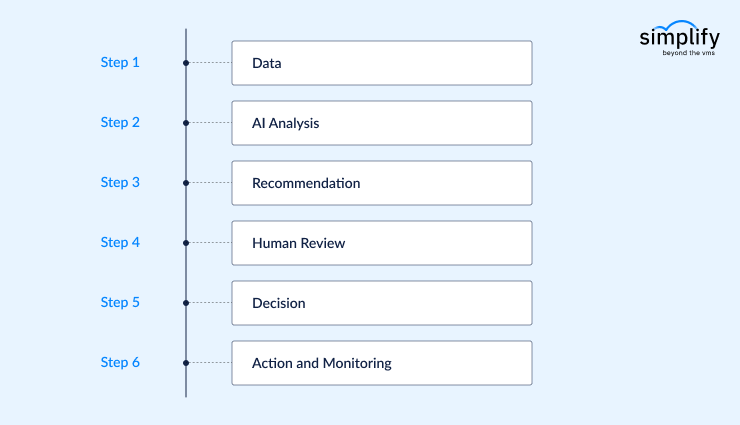
A practical AI-assisted VMS workflow can follow a clear process, from collecting data and generating recommendations to human review, decision-making, and ongoing monitoring.
Who Makes the Final Call?
The final decision depends on the type of task, the level of risk, and how much human judgment is needed. AI can analyze information, make recommendations, summarize data, raise alerts, and automate tasks such as routing requests, sending notifications, checking information, and moving workflows to the next step, while people review the information, add business context, approve actions, and make decisions.
For routine and clearly defined workflows, organizations may use more automation. For complex or important decisions, human review can remain part of the process.
SimplifyVMS clearly defines where AI provides recommendations and insights, where automation handles defined workflow tasks, and where human judgment and approval remain necessary.
It should ask: “What information can AI provide, what can be automated, and where does human judgment add the most value?” A clear balance between AI, automation, and human judgment can make AI more practical in modern workforce management.
Final Thoughts
AI does not need to replace human decision-making to create value in a VMS. Its value can come from helping people work with more information, identify important patterns, reduce repetitive work, and make decisions with better visibility.
SimplifyVMS brings together AI/ML, GenAI and LLM capabilities, automation, analytics, compliance intelligence, risk detection, and configurable workflows to support modern workforce management.
The model is simple:
AI provides intelligence. Automation handles defined tasks. People provide judgment and accountability.
When these capabilities work together, organizations can build VMS workflows that reduce manual effort, improve visibility, and support better-informed decisions while keeping people involved in important decisions.
That’s all for today. We hope you found this article on AI and human decision-making in VMS insightful. If you’d like to learn more about AI-powered VMS and workforce management, these resources may help:
What Happens When Every VMS Workflow Becomes AI-Assisted?
How Does SOW Management Add Structure to Services Procurement?
How Does AI Help Healthcare Organizations Manage Staffing Gaps?


-02.jpg?width=352&name=Vendor%20Contracts%20Explained%20(cover)-02.jpg)
Your comments