

| Resources
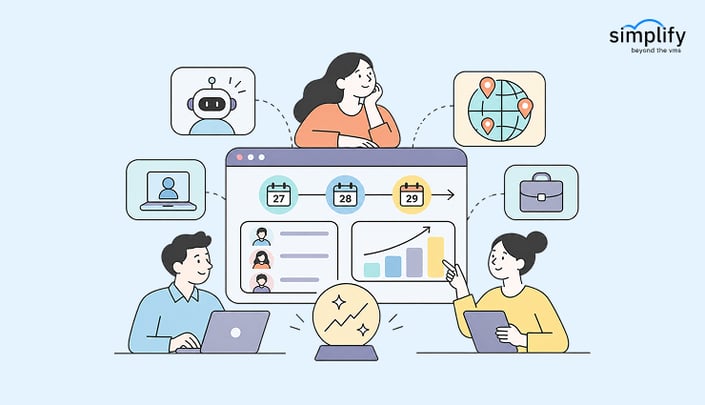
For years, organizations expanded their external workforce by adding more contractors, temporary workers, freelancers, and service providers.
But managing a larger workforce is no longer the biggest challenge. The real challenge is understanding how that workforce contributes to business outcomes.
As regulations evolve, skill requirements change and AI becomes part of everyday operations; contingent workforce management is entering a new phase.
Between 2027 and 2029, three developments will shape this transformation: continuous compliance, AI-powered operations, and skills-based workforce planning.
Three Forces Reshaping Contingent Workforce Management
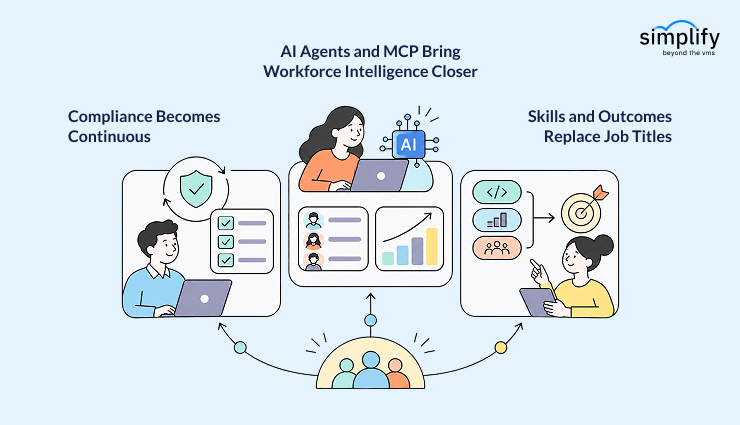
Force 1: Compliance Becomes Continuous
For instance, The EU Platform Work Directive, with a national transposition deadline of 2 December 2026, makes 2027 an important period for organizations operating in the European market. While the directive specifically addresses platform work, it highlights the growing importance of worker classification, transparency, and accountability.
Compliance can no longer be treated as a final checkpoint before onboarding. It needs to be embedded throughout the engagement lifecycle.
Organizations should prioritize:
- Documenting worker classification and compliance decisions.
- Maintaining country-specific records and contractual obligations.
- Creating audit trails across the workforce lifecycle.
- Automating compliance checks wherever possible.
Where technology helps: SimplifyVMS supports workforce compliance through centralized compliance data, configurable compliance workflows, and AI-powered validation, helping organizations manage requirements across regions.
Force 2: AI Agents and MCP Bring Workforce Intelligence Closer
AI in workforce management is moving beyond basic automation. Organizations are beginning to explore AI agents that can handle operational tasks such as candidate matching, SOW comparison, document review, interview automation, and compliance validation.
Unlike traditional rule-based automation, AI-powered workflows can interpret information, identify patterns and support more informed decisions, with human oversight where required.
Another development gaining momentum is the Model Context Protocol (MCP).
MCP is an open standard that allows AI applications to connect with enterprise systems, data sources, and tools through a common interface. Instead of switching between multiple applications, users can access relevant business information through the AI platforms they already use.
For workforce management, this creates new possibilities.
Imagine asking an AI assistant for yesterday's job requisitions, candidate matches, onboarding progress or workforce spend without manually navigating multiple systems.
SimplifyVMS is bringing this approach to workforce management through its MCP Server. It connects SimplifyVMS with AI platforms such as ChatGPT and Claude, while extending access across connected workforce systems such as HR platforms and ATS solutions.
Through natural-language interactions, users can access workforce information and insights across their connected ecosystem.
What organizations should prepare for: As AI agents and MCP become part of enterprise operations, businesses will need clear access permissions, data governance, auditability and human oversight.
Force 3: Skills and Outcomes Replace Job Titles
Traditional workforce planning often begins with job titles, experience requirements, and headcount targets. The next phase will increasingly focus on skills, capabilities, and business outcomes.
Consider the difference:
- Traditional: Senior Business Analyst with five years of experience.
- Skills-based: Professional experienced in process automation, data analysis and integrating AI tools into business operations.
The second approach expands talent pools, identifies transferable skills, and supports better talent matching.
It also changes the workforce planning question from "How do we fill this position?" to "What combination of people, skills, suppliers and technology will deliver this outcome?"
This is the foundation of Total Workforce Management, where permanent employees, contractors, freelancers, SOW teams, and digital workers are considered together.
SimplifyVMS supports this connected approach through AI-powered candidate matching, skills intelligence and Brigge, its enterprise integration platform. Brigge automates data exchange across HR, ERP, finance and other enterprise applications, helping reduce silos and improve workforce visibility.
Where to start: Review recurring workforce requirements and redefine them around skills and deliverables rather than job titles alone.
How Ready Is Your External Workforce Program?
Before exploring these trends, assess where your organization stands.
Answer each question with Not Yet (0), Partly (1) or Yes (2).
- Do you have centralized visibility into contractors, freelancers and SOW engagements?
- Are worker classification and compliance requirements documented before engagements begin?
- Do your VMS, HR, procurement and finance systems exchange data seamlessly?
- Are AI and automation improving measurable workforce management processes?
- Do you have clear governance policies for AI-assisted decisions and automated workflows?
Your score:
- 0–3 | Early Stage: Focus on workforce visibility, centralized data and governance.
- 4–7 | Building Foundations: Improve integration, compliance and process consistency.
- 8–10 | Future-Ready: Prioritize AI adoption, intelligent automation and workforce planning.
Assess Your Workforce Program with SimplifyVMS
The Bottom Line
The next three years will change how organizations source, manage, and optimize their external workforce. Compliance will become more embedded, AI agents will take on more operational work, MCP will bring enterprise information closer to users, and skills will play a bigger role in workforce planning.
Organizations that prepare for this shift will need more than systems that track suppliers, workers, and invoices. They will need connected technology that brings workforce data, intelligence, and automation together.
SimplifyVMS brings these capabilities together through its AI-first VMS platform, combining contingent workforce management, services procurement, intelligent automation, compliance and enterprise integrations.
Recognized as a Global Leader and Star Performer in Everest Group's 2026 PEAK Matrix® Assessment for Vendor Management Systems, SimplifyVMS continues to advance workforce management through connected technology and AI-powered capabilities.
The future isn't about managing more workers. It's about making smarter decisions about how work gets done.
That's all for today. We hope you found this article helpful. To explore more about contingent workforce management, AI in workforce operations, and VMS technology, you may find these related articles useful:
Who Makes the Final Call? AI Insights vs. Human Decisions in AI-Powered VMS
Agentic AI in Staffing: A Guide to Automation and Workforce Management
How AI Helps Healthcare Organizations Overcome Staffing Shortages
Frequently Asked Questions
1. What is the future of contingent workforce management?
It is moving towards connected workforce ecosystems powered by AI, continuous compliance, skills-based sourcing, and integrated workforce planning.
2. How will AI agents change workforce management?
AI agents will help automate tasks such as candidate matching, SOW review, compliance validation and invoice processing, allowing teams to focus on decisions that require human judgment.
3. What is MCP and why does it matter to workforce management?
Model Context Protocol (MCP) is an open standard that connects AI applications with enterprise systems and data. It allows users to access workforce information through supported AI platforms without constantly switching between applications.
4. What is Total Workforce Management?
It is an approach to planning and managing permanent employees, contractors, freelancers, temporary workers, SOW teams, and digital workers together.
5. What should organizations look for in a modern VMS?
Organizations should prioritize AI capabilities, compliance management, workforce visibility, SOW management, skills intelligence, enterprise integrations, and scalability.


Your comments