---
title: Is the Contingent Workforce Replacing the Traditional Org Chart?
description: Is the contingent workforce redefining org charts? How leaders must rethink workforce structure, visibility, and execution.
image: https://insights.simplifyvms.com/hubfs/Is%20the%20Contingent%20Workforce%20Replacing%20the%20Traditional%20Org%20Chart.jpg
---
SimplifyVMS Recognized as a Global Leader and Star Performer in Everest Group’s 2026 PEAK Matrix® Assessment for Vendor Management Systems (VMS)

[Skip to content](https://insights.simplifyvms.com/resources/is-the-contingent-workforce-replacing-the-traditional-org-chart#main-content)
[](https://www.simplifyvms.com/)
- Why Simplify?
Show submenu for Why Simplify?
- [Simplify Your Complexity](https://www.simplifyvms.com/#simplify-your-complexity)
- [Our Technology Difference](https://www.simplifyvms.com/#our-technology-difference)
- [How We Are Different](https://www.simplifyvms.com/#how-we-are-different)
- [What Customers Are Saying](https://www.simplifyvms.com/#testimonials)
- Solutions
Show submenu for Solutions

- Flexible Workforce Solutions
Show submenu for Flexible Workforce Solutions
- [Vendor Management System (VMS)](https://www.simplifyvms.com/solutions/vendor-management-system/)
- [Direct Sourcing And Talent Pools](https://www.simplifyvms.com/solutions/directsourcing/)
- [Services Procurement](https://www.simplifyvms.com/solutions/services-procurement/)
- [Healthcare Credentialing](https://www.simplifyvms.com/solutions/credentialing/)
- [Artificial Intelligence Suite](https://www.simplifyvms.com/solutions/artificial-intelligence-suite/)
- [Neurodiverse Talent Solutions](https://www.simplifyvms.com/solutions/neurodiverse-talent-sourcing/)
- Integrations
Show submenu for Integrations
- [Integration Platform](https://www.simplifyvms.com/solutions/integration-platform/)
- [Partnerships](https://www.simplifyvms.com/partnerships/)
- Resources
Show submenu for Resources

- Blogs
Show submenu for Blogs
- [Insights](https://insights.simplifyvms.com/resources)
- [Recruitment](https://insights.simplifyvms.com/resources/tag/recruitment)
- [Vendor Management](https://insights.simplifyvms.com/resources/tag/vendor-management)
- [Service Procurement](https://insights.simplifyvms.com/resources/tag/service-procurement)
- Knowledge Hub
Show submenu for Knowledge Hub
- [Guides for Vendors](https://insights.simplifyvms.com/guides-for-vendors?hsLang=en)
- [Guides for Business](https://insights.simplifyvms.com/guides-for-business?hsLang=en)
- [Whitepapers](https://insights.simplifyvms.com/white-papers?hsLang=en)
- Client Stories
Show submenu for Client Stories
- [Case Studies](https://insights.simplifyvms.com/?hsLang=en)
- Community & Events
Show submenu for Community & Events
- [Customer Advisory Board](https://www.simplifyvms.com/resources/customer-advisory-board/)
- [Events](https://www.simplifyvms.com/resources/events/)
- [Simplify Talks](https://www.simplifyvms.com/resources/simplify-talks/)
- Standard Agreement
Show submenu for Standard Agreement
- [Mutual NDA](https://www.simplifyvms.com/resources/mutualnda/)
- [Data Protection Addendum](https://www.simplifyvms.com/simplifyworkforce-data-protection-addendum.pdf)
- Company
Show submenu for Company

- About
Show submenu for About
- [Our Vision](https://www.simplifyvms.com/company/about/#vision)
- [Our Mission](https://www.simplifyvms.com/company/about/#mission)
- [Our Values](https://www.simplifyvms.com/company/about/#core-values)
- [Leadership Team](https://www.simplifyvms.com/company/about/#leadership)
- [Get In Touch](https://www.simplifyvms.com/company/get-in-touch/)
- Life @Simplify
Show submenu for Life @Simplify
- [Careers](https://www.simplifyvms.com/company/careers/)
- Why Simplify?
Show submenu for Why Simplify?
- [Simplify Your Complexity](https://www.simplifyvms.com/#simplify-your-complexity)
- [Our Technology Difference](https://www.simplifyvms.com/#our-technology-difference)
- [How We Are Different](https://www.simplifyvms.com/#how-we-are-different)
- [What Customers Are Saying](https://www.simplifyvms.com/#testimonials)
- Solutions
Show submenu for Solutions

- Flexible Workforce Solutions
Show submenu for Flexible Workforce Solutions
- [Vendor Management System (VMS)](https://www.simplifyvms.com/solutions/vendor-management-system/)
- [Direct Sourcing And Talent Pools](https://www.simplifyvms.com/solutions/directsourcing/)
- [Services Procurement](https://www.simplifyvms.com/solutions/services-procurement/)
- [Healthcare Credentialing](https://www.simplifyvms.com/solutions/credentialing/)
- [Artificial Intelligence Suite](https://www.simplifyvms.com/solutions/artificial-intelligence-suite/)
- [Neurodiverse Talent Solutions](https://www.simplifyvms.com/solutions/neurodiverse-talent-sourcing/)
- Integrations
Show submenu for Integrations
- [Integration Platform](https://www.simplifyvms.com/solutions/integration-platform/)
- [Partnerships](https://www.simplifyvms.com/partnerships/)
- Resources
Show submenu for Resources

- Blogs
Show submenu for Blogs
- [Insights](https://insights.simplifyvms.com/resources)
- [Recruitment](https://insights.simplifyvms.com/resources/tag/recruitment)
- [Vendor Management](https://insights.simplifyvms.com/resources/tag/vendor-management)
- [Service Procurement](https://insights.simplifyvms.com/resources/tag/service-procurement)
- Knowledge Hub
Show submenu for Knowledge Hub
- [Guides for Vendors](https://insights.simplifyvms.com/guides-for-vendors?hsLang=en)
- [Guides for Business](https://insights.simplifyvms.com/guides-for-business?hsLang=en)
- [Whitepapers](https://insights.simplifyvms.com/white-papers?hsLang=en)
- Client Stories
Show submenu for Client Stories
- [Case Studies](https://insights.simplifyvms.com/?hsLang=en)
- Community & Events
Show submenu for Community & Events
- [Customer Advisory Board](https://www.simplifyvms.com/resources/customer-advisory-board/)
- [Events](https://www.simplifyvms.com/resources/events/)
- [Simplify Talks](https://www.simplifyvms.com/resources/simplify-talks/)
- Standard Agreement
Show submenu for Standard Agreement
- [Mutual NDA](https://www.simplifyvms.com/resources/mutualnda/)
- [Data Protection Addendum](https://www.simplifyvms.com/simplifyworkforce-data-protection-addendum.pdf)
- Company
Show submenu for Company

- About
Show submenu for About
- [Our Vision](https://www.simplifyvms.com/company/about/#vision)
- [Our Mission](https://www.simplifyvms.com/company/about/#mission)
- [Our Values](https://www.simplifyvms.com/company/about/#core-values)
- [Leadership Team](https://www.simplifyvms.com/company/about/#leadership)
- [Get In Touch](https://www.simplifyvms.com/company/get-in-touch/)
- Life @Simplify
Show submenu for Life @Simplify
- [Careers](https://www.simplifyvms.com/company/careers/)
[Request A Demo](https://www.simplifyvms.com/demo/)
# Is the Contingent Workforce Replacing the Traditional Org Chart? | Resources
*by* [Arun Kumar - AI & SaaS Content Specialist, SimplifyVMS](https://insights.simplifyvms.com/resources/author/arun-kumar-ai-saas-content-specialist)
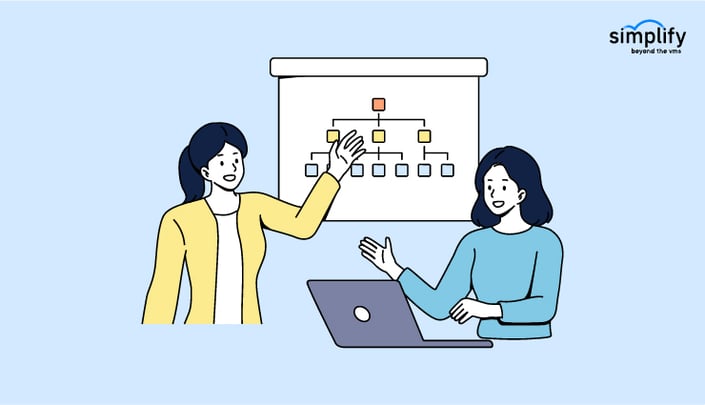
For senior leaders, the organizational chart has long been a planning tool defining accountability, cost structures, and operational scale. But across industries, that framework is being tested.
The question facing today’s leadership teams is not whether the contingent workforce is growing, the real question is whether traditional org structures are still sufficient to govern, measure, and optimize how work actually gets done.
### **The Org Chart No Longer Reflects Reality**
Most org charts still represent only permanent headcounts. Yet in many enterprises, **30–50% of the workforce delivering critical outcomes is non-employee labor** like contractors, consultants, freelancers, and SOW-based providers.
These individuals may lead digital programs, run compliance initiatives, or deliver revenue-impacting projects without ever appearing in workforce planning models or leadership dashboards.
For executives, this creates a visibility gap:
- CHROs lack a complete view of workforce capability and capacity
- CFOs see spend but not performance or dependency risk
- CEOs make strategic bets without a full picture of who is executing them
An org chart that excludes this workforce is no longer a reliable management instrument.
### **Work Is Being Organized Around Capabilities, Not Positions**
The pace of change has fundamentally altered how work is structured.
Organizations now compete on speed, specialization, and adaptability, enabled by [flexible workforce solutions](https://www.simplifyvms.com/solutions/vendor-management-system/). That requires assembling teams around capabilities and outcomes, not fixed roles.
Contingent talent enables this shift by allowing organizations to:
- Access scarce skills without long-term cost commitments
- Scale execution in response to market demand
- Reduce structural risk while accelerating transformation initiatives
The result is a workforce model that is fluid, modular, and increasingly decoupled from traditional hierarchies.
### **The Financial and Operational Implications Are Material**
From a CFO’s perspective, the contingent workforce is no longer a tactical expense; it is a material component of operating cost and risk.
Without integrated governance, organizations face:
- Fragmented spend across vendors and regions
- Inconsistent rate cards and contract terms
- Elevated compliance and misclassification exposure
- Limited leverage in supplier negotiations
For CHROs, the challenge is equally significant:
- Workforce planning based only on employees is incomplete
- Skill inventories ignore critical external capabilities
- Culture, knowledge transfer, and performance accountability become harder to manage
These are no longer functional issues; they are enterprise risks.
### **The Org Chart Is Not Disappearing, but It is Insufficient**
This is not an argument to eliminate traditional structures. Employees remain essential for leadership, continuity, institutional knowledge, and culture.
However, the org chart alone cannot govern a blended workforce model.
Leading organizations are evolving toward:
- Integrated views of employee and non-employee labor
- Workforce strategies anchored in capabilities rather than headcount
- Outcome-based governance models supported by real-time data
- Technology platforms that provide enterprise-wide visibility
In this model, the org chart becomes a foundation not the full picture.
### **What Executive Leadership Must Do Next?**
To remain competitive and resilient, leadership teams should:
*1. Elevate contingent workforce strategy to the executive agenda*
*2. Demand consolidated visibility across labor types, spend, and outcomes*
*3. Shift planning discussions from “how many people” to “what capabilities”*
*4. Align HR, Finance, Procurement, and Legal under a unified governance model*
*5. Measure value delivered not just cost incurred*
This is where leadership teams should leverage comprehensive solutions like [contingent workforce management software](https://www.simplifyvms.com/) to track, manage, and enhance multiple aspects of the extended workforce.
### **Executive Takeaway on Contingent Workforce Management**
The contingent workforce is not replacing the traditional org chart.
It is redefining the limits of what the org chart can explain.
For CHROs, CFOs, and CEOs, the mandate is clear: lead the shift from static structures to dynamic workforce intelligence or be governed by models that no longer reflect how your organization truly operates.
The contingent workforce industry is undergoing a paradigm shift and organizations which can be flexible and supported with AI-first tech stack can gain competitive advantage.
That’s all for today.
Here are some additional resources on contingent workforce management that you should definitely check out:
- [Top 5 KPIs to Accurately Measure Flexible Talent Performance](https://insights.simplifyvms.com/resources/top-kpis-how-to-measure-true-performance-of-flexible-talent?hsLang=en)
- [Key Healthcare Contingent Workforce Trends Driving Change](https://www.healthcarevms.com/articles/healthcare-contingent-workforce-trends/)
- [Agentic AI Explained: Transforming Staffing Automation & Workforce Management](https://insights.simplifyvms.com/resources/agentic-ai-guide-staffing-automation-workforce-management?hsLang=en)
[Vendor Management](https://insights.simplifyvms.com/resources/tag/vendor-management)

#### Arun Kumar
AI & SaaS Content Specialist, SimplifyVMS
A content professional with 7+ years of experience focused on SaaS, AI, automation, digital transformation, and emerging technology trends. Passionate about reading and writing technology and SaaS-focused content that helps businesses understand complex technology, explore industry trends, and address real-world challenges. Particularly interested in how AI and technology are shaping the future of the contingent workforce industry.
#### Don't forget to share this Post
##### Your comments
#### Subscribe Now
Discover the latest industry trends on flexible workforce and free tips and hacks to enhance vendor performance.
##### Connect With Us
###### Blog Topics
- [Vendor Management](https://insights.simplifyvms.com/resources/tag/vendor-management)
- [Service Procurement](https://insights.simplifyvms.com/resources/tag/service-procurement)
- [Recruitment](https://insights.simplifyvms.com/resources/tag/recruitment)
- [Healthcare](https://insights.simplifyvms.com/resources/tag/healthcare)
###### Popular Posts
## Read On
[](https://insights.simplifyvms.com/resources/what-it-takes-to-win-your-cto-over-on-a-vms?hsLang=en)
### [What It Takes to Win Your CTO Over on a VMS?](https://insights.simplifyvms.com/resources/what-it-takes-to-win-your-cto-over-on-a-vms?hsLang=en)
For years, Vendor Management Systems (VMS) have been largely viewed as procurement tools.
[](https://insights.simplifyvms.com/resources/risk-management-for-global-gig-workers-avoid-costly-mistakes?hsLang=en)
### [Risk Management for Global Gig Workers: How to Avoid Costly Mistakes?](https://insights.simplifyvms.com/resources/risk-management-for-global-gig-workers-avoid-costly-mistakes?hsLang=en)
Does your business involve operations across multiple business units comprising global gig workers?
[](https://insights.simplifyvms.com/resources/top-15-key-trends-shaping-the-future-of-contingent-workforce-management?hsLang=en)
### [Top 15 Key Trends Shaping the Future of Contingent Workforce Management](https://insights.simplifyvms.com/resources/top-15-key-trends-shaping-the-future-of-contingent-workforce-management?hsLang=en)
The extended workforce is growing at a remarkable pace. A late 2022 report placed the broad...
[](https://www.simplifyvms.com/)
We provide flexible technology solutions to build and manage a workforce ecosystem that can adapt to changing needs and demands. We empower clients with the tools and resources needed to thrive in today’s ever-changing business landscape
##### Company
- [Our Vision](https://www.simplifyvms.com/company/about/#about)
- [Our Mission](https://www.simplifyvms.com/company/about/#mission)
- [Our Values](https://www.simplifyvms.com/company/about/#core-values)
- [Leadership Team](https://www.simplifyvms.com/company/about/#leadership)
- [Get in Touch](https://www.simplifyvms.com/company/get-in-touch/)
##### Information
- [Request A Demo](https://www.simplifyvms.com/demo/)
- [Careers](https://www.simplifyvms.com/company/careers/)
- [Case Studies](https://insights.simplifyvms.com/)
- [Webinar](https://www.simplifyvms.com/resources/webinar/)
- [Privacy Policy](https://www.simplifyvms.com/privacy-policy/)
##### Our Locations
- [USA - Headquarters](https://www.simplifyvms.com/company/our-locations/#usa)
- [India](https://www.simplifyvms.com/company/our-locations/#india)
- [Europe](https://www.simplifyvms.com/company/our-locations/#europe)
- [Canada](https://www.simplifyvms.com/company/our-locations/#canada)
- [Accessibility Statement](https://www.simplifyvms.com/accessibility-statement)
- [Trust Center](https://www.simplifyvms.com/trust-center)
- [Modern Slavery Act Statement](https://www.simplifyvms.com/modern-slavery-policy)
- [Supplier Code of Conduct](https://www.simplifyvms.com/human-rights/)
- [Privacy Policy](https://www.simplifyvms.com/privacy-policy)
- [Copyright Policy](https://www.simplifyvms.com/copy-right)
©2026 Simplify. All rights reserved.
```json
{
"@context" : "https://schema.org",
"@type" : "BlogPosting",
"author" : {
"@type" : "Person",
"name" : "Arun Kumar - AI & SaaS Content Specialist, SimplifyVMS",
"url" : "https://insights.simplifyvms.com/resources/author/arun-kumar-ai-saas-content-specialist"
},
"dateModified" : "2026-10-08T06:57:15.832Z",
"datePublished" : "2026-01-27T07:14:54.000Z",
"headline" : "Is the Contingent Workforce Replacing the Traditional Org Chart?",
"image" : [ "https://insights.simplifyvms.com/hubfs/Is%20the%20Contingent%20Workforce%20Replacing%20the%20Traditional%20Org%20Chart.jpg" ],
"mainEntityOfPage" : {
"@id" : "https://insights.simplifyvms.com/resources/is-the-contingent-workforce-replacing-the-traditional-org-chart",
"@type" : "WebPage"
},
"publisher" : {
"@type" : "Organization",
"logo" : {
"@type" : "ImageObject"
},
"name" : "Simplify Workforce"
}
}
```
```json
{
"@context" : "https://schema.org",
"@type" : "BlogPosting",
"author" : {
"@type" : "Organization",
"name" : ""
},
"dateModified" : "2026-04-07",
"datePublished" : "2026-04-01",
"description" : "This blog explores how the growing contingent workforce is reshaping traditional organizational structures. It explains why conventional org charts no longer reflect the full workforce, highlights the shift toward capability-based, flexible team models, and outlines the strategic, financial, and governance implications for modern enterprises.",
"headline" : "Is the Contingent Workforce Replacing the Traditional Org Chart?",
"image" : "",
"mainEntityOfPage" : {
"@id" : "https://insights.simplifyvms.com/resources/is-the-contingent-workforce-replacing-the-traditional-org-chart",
"@type" : "WebPage"
},
"publisher" : {
"@type" : "Organization",
"logo" : {
"@type" : "ImageObject",
"url" : ""
},
"name" : ""
}
}
```