---
title: What Happens When Every VMS Workflow Is AI-Assisted?
description: Discover how AI-assisted VMS technology is transforming sourcing, talent matching, onboarding, assignment management and extensions across the contingent workforce lifecycle.
image: https://insights.simplifyvms.com/hubfs/What%20Happens%20When%20Every%20VMS%20Workflow%20Is%20AI-Assisted_.png
---
SimplifyVMS Recognized as a Global Leader and Star Performer in Everest Group’s 2026 PEAK Matrix® Assessment for Vendor Management Systems (VMS)

[Skip to content](https://insights.simplifyvms.com/resources/what-happens-when-every-vms-workflow-is-ai-assisted#main-content)
[](https://www.simplifyvms.com/)
- Why Simplify?
Show submenu for Why Simplify?
- [Simplify Your Complexity](https://www.simplifyvms.com/#simplify-your-complexity)
- [Our Technology Difference](https://www.simplifyvms.com/#our-technology-difference)
- [How We Are Different](https://www.simplifyvms.com/#how-we-are-different)
- [What Customers Are Saying](https://www.simplifyvms.com/#testimonials)
- Solutions
Show submenu for Solutions

- Flexible Workforce Solutions
Show submenu for Flexible Workforce Solutions
- [Vendor Management System (VMS)](https://www.simplifyvms.com/solutions/vendor-management-system/)
- [Direct Sourcing And Talent Pools](https://www.simplifyvms.com/solutions/directsourcing/)
- [Services Procurement](https://www.simplifyvms.com/solutions/services-procurement/)
- [Healthcare Credentialing](https://www.simplifyvms.com/solutions/credentialing/)
- [Artificial Intelligence Suite](https://www.simplifyvms.com/solutions/artificial-intelligence-suite/)
- [Neurodiverse Talent Solutions](https://www.simplifyvms.com/solutions/neurodiverse-talent-sourcing/)
- Integrations
Show submenu for Integrations
- [Integration Platform](https://www.simplifyvms.com/solutions/integration-platform/)
- [Partnerships](https://www.simplifyvms.com/partnerships/)
- Resources
Show submenu for Resources

- Blogs
Show submenu for Blogs
- [Insights](https://insights.simplifyvms.com/resources)
- [Recruitment](https://insights.simplifyvms.com/resources/tag/recruitment)
- [Vendor Management](https://insights.simplifyvms.com/resources/tag/vendor-management)
- [Service Procurement](https://insights.simplifyvms.com/resources/tag/service-procurement)
- Knowledge Hub
Show submenu for Knowledge Hub
- [Guides for Vendors](https://insights.simplifyvms.com/guides-for-vendors?hsLang=en)
- [Guides for Business](https://insights.simplifyvms.com/guides-for-business?hsLang=en)
- [Whitepapers](https://insights.simplifyvms.com/white-papers?hsLang=en)
- Client Stories
Show submenu for Client Stories
- [Case Studies](https://insights.simplifyvms.com/?hsLang=en)
- Community & Events
Show submenu for Community & Events
- [Customer Advisory Board](https://www.simplifyvms.com/resources/customer-advisory-board/)
- [Events](https://www.simplifyvms.com/resources/events/)
- [Simplify Talks](https://www.simplifyvms.com/resources/simplify-talks/)
- Standard Agreement
Show submenu for Standard Agreement
- [Mutual NDA](https://www.simplifyvms.com/resources/mutualnda/)
- [Data Protection Addendum](https://www.simplifyvms.com/simplifyworkforce-data-protection-addendum.pdf)
- Company
Show submenu for Company

- About
Show submenu for About
- [Our Vision](https://www.simplifyvms.com/company/about/#vision)
- [Our Mission](https://www.simplifyvms.com/company/about/#mission)
- [Our Values](https://www.simplifyvms.com/company/about/#core-values)
- [Leadership Team](https://www.simplifyvms.com/company/about/#leadership)
- [Get In Touch](https://www.simplifyvms.com/company/get-in-touch/)
- Life @Simplify
Show submenu for Life @Simplify
- [Careers](https://www.simplifyvms.com/company/careers/)
- Why Simplify?
Show submenu for Why Simplify?
- [Simplify Your Complexity](https://www.simplifyvms.com/#simplify-your-complexity)
- [Our Technology Difference](https://www.simplifyvms.com/#our-technology-difference)
- [How We Are Different](https://www.simplifyvms.com/#how-we-are-different)
- [What Customers Are Saying](https://www.simplifyvms.com/#testimonials)
- Solutions
Show submenu for Solutions

- Flexible Workforce Solutions
Show submenu for Flexible Workforce Solutions
- [Vendor Management System (VMS)](https://www.simplifyvms.com/solutions/vendor-management-system/)
- [Direct Sourcing And Talent Pools](https://www.simplifyvms.com/solutions/directsourcing/)
- [Services Procurement](https://www.simplifyvms.com/solutions/services-procurement/)
- [Healthcare Credentialing](https://www.simplifyvms.com/solutions/credentialing/)
- [Artificial Intelligence Suite](https://www.simplifyvms.com/solutions/artificial-intelligence-suite/)
- [Neurodiverse Talent Solutions](https://www.simplifyvms.com/solutions/neurodiverse-talent-sourcing/)
- Integrations
Show submenu for Integrations
- [Integration Platform](https://www.simplifyvms.com/solutions/integration-platform/)
- [Partnerships](https://www.simplifyvms.com/partnerships/)
- Resources
Show submenu for Resources

- Blogs
Show submenu for Blogs
- [Insights](https://insights.simplifyvms.com/resources)
- [Recruitment](https://insights.simplifyvms.com/resources/tag/recruitment)
- [Vendor Management](https://insights.simplifyvms.com/resources/tag/vendor-management)
- [Service Procurement](https://insights.simplifyvms.com/resources/tag/service-procurement)
- Knowledge Hub
Show submenu for Knowledge Hub
- [Guides for Vendors](https://insights.simplifyvms.com/guides-for-vendors?hsLang=en)
- [Guides for Business](https://insights.simplifyvms.com/guides-for-business?hsLang=en)
- [Whitepapers](https://insights.simplifyvms.com/white-papers?hsLang=en)
- Client Stories
Show submenu for Client Stories
- [Case Studies](https://insights.simplifyvms.com/?hsLang=en)
- Community & Events
Show submenu for Community & Events
- [Customer Advisory Board](https://www.simplifyvms.com/resources/customer-advisory-board/)
- [Events](https://www.simplifyvms.com/resources/events/)
- [Simplify Talks](https://www.simplifyvms.com/resources/simplify-talks/)
- Standard Agreement
Show submenu for Standard Agreement
- [Mutual NDA](https://www.simplifyvms.com/resources/mutualnda/)
- [Data Protection Addendum](https://www.simplifyvms.com/simplifyworkforce-data-protection-addendum.pdf)
- Company
Show submenu for Company

- About
Show submenu for About
- [Our Vision](https://www.simplifyvms.com/company/about/#vision)
- [Our Mission](https://www.simplifyvms.com/company/about/#mission)
- [Our Values](https://www.simplifyvms.com/company/about/#core-values)
- [Leadership Team](https://www.simplifyvms.com/company/about/#leadership)
- [Get In Touch](https://www.simplifyvms.com/company/get-in-touch/)
- Life @Simplify
Show submenu for Life @Simplify
- [Careers](https://www.simplifyvms.com/company/careers/)
[Request A Demo](https://www.simplifyvms.com/demo/)
# What Happens When Every VMS Workflow Is AI-Assisted? | Resources
*by* [Divya Ananth - Head of Marketing, SimplifyVMS](https://insights.simplifyvms.com/resources/author/divya-ananth)
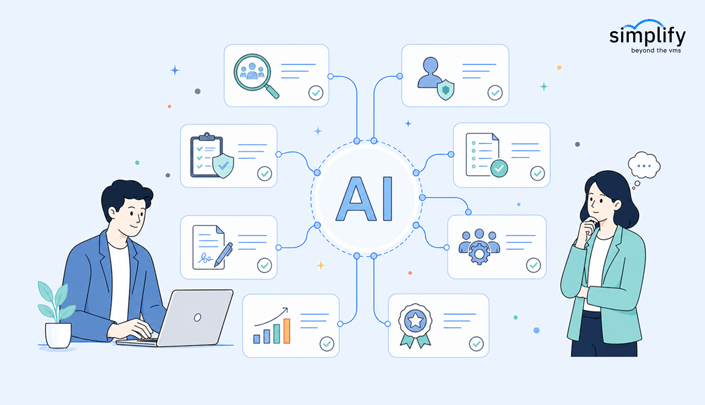
From sourcing to matching, onboarding to extensions, AI is changing what a Vendor Management System can do. The real opportunity isn't adding AI to individual features. It's making intelligence part of the entire contingent workforce lifecycle.
For years, [Vendor Management Systems (VMS)](https://www.simplifyvms.com/solutions/vendor-management-system/) have been the operational backbone of contingent workforce programs.
VMS helped organizations create requisitions, manage staffing suppliers, compare candidates, manage onboarding, track assignments, process extensions, measure performance, and maintain compliance.
But most of these workflows have traditionally depended on people to move information from one step to the next.
A program manager reviews a requisition.
A recruiter searches through candidates.
A hiring manager compares profiles.
Someone checks documentation.
Someone follows up on an expiring assignment.
Someone else identifies that an extension is needed.
AI changes the equation.
When intelligence is embedded across the VMS workflow, AI can help move work forward at every stage, using context from the previous stage to inform the next one.
The result isn't simply a VMS with more AI features. It is a more intelligent workforce orchestration layer.
In this post, we will explore what happens when end-to-end contingent workforce management workflows are assisted by orchestrated AI intelligence.
Let's begin by understanding AI-assisted workflows.
## What are AI-Assisted Workflows?
There is an important distinction between [adding AI to a VMS and building AI assistance into the VMS workflow.](https://insights.simplifyvms.com/white-paper-bolted-on-vs.-built-in-choosing-the-right-workforce-technology?hsLang=en)
A traditional approach might look like this:
**VMS → AI chatbot**
Or:
**VMS → AI-powered matching feature**
These capabilities can be useful, but they operate within individual touchpoints.
An AI-assisted VMS takes a broader approach:
**Requisition → Sourcing → Matching → Selection → Onboarding → Assignment → Extension → Offboarding**
At each stage, AI can analyze information, identify patterns, recommend actions, automate repetitive work, and surface the next best action.
That creates a continuous intelligence layer across the contingent workforce lifecycle.
### 1. Sourcing: From “Find Candidates” to “Find Ideal Fits”
Sourcing is often where workforce programs lose valuable time.
A requisition is created. Suppliers are notified. Recruiters search databases and job boards. Candidates are submitted. And program teams wait for the right talent to emerge.
AI can fundamentally revolutionize this process.
Instead of simply searching for candidates based on keywords, AI can understand the **intent behind a role**.
For example, a requisition may ask for:
“Senior data engineer with Python, AWS and experience building scalable data pipelines.”
A conventional search might focus on those exact keywords.
An AI-assisted workflow can look beyond the literal wording and understand related skills, transferable experience, seniority, industry context, and adjacent capabilities.
It can help:
- Generate or improve job descriptions
- Identify required versus preferred skills
- Expand searches using related skills
- Recommend potential talent pools
- Surface previously engaged candidates
- Identify internal or direct-sourced talent
- Assist recruiters with candidate outreach
- Benchmark compensation expectations
- Prioritize candidates based on role requirements
The result is a shift from searching harder to searching intelligently.
And because the AI is operating inside the VMS workflow, sourcing intelligence can be informed by the organization's existing workforce data, policies and hiring context.
### 2. Matching: From Keyword Search to Skills Intelligence
Finding candidates is only half of the challenge.
The bigger question is:
**Which candidate is most likely to succeed in this role?**
Traditional VMS matching often relies heavily on resumes, keywords, supplier submissions, and recruiter judgment.
AI can introduce a more contextual approach.
An AI-assisted matching engine can evaluate candidates against multiple dimensions, including:
- Skills
- Relevant experience
- Role requirements
- Industry experience
- Location
- Availability
- Compensation
- Certifications
- Related or transferable skills
This creates a shift from **resume matching** to **skills-based matching**.
Consider two candidates.
Candidate A has the exact job title requested but limited experience in the specific environment.
Candidate B has a different title but has worked extensively with the technologies, workflows, and business problems relevant to the role.
A keyword-based system may rank Candidate A higher.
An AI-assisted system can recognize the relevance of Candidate B's experience.
This is where AI becomes more than a feature. It becomes a decision-support layer for the hiring process.
### 3. Onboarding: From Administrative Process to Intelligent Workflow
Once a candidate is selected, the work isn't over.
Onboarding can involve documentation, compliance checks, background verification, certifications, training, system access, and multiple approvals.
For global enterprises, the complexity increases further because requirements can vary by:
- Country
- Worker type
- Assignment type
- Client
- Role
- Industry
- Regulatory requirements
AI can help orchestrate this complexity.
Instead of treating onboarding as a fixed checklist, an [AI-powered VMS](https://www.simplifyvms.com/) can determine which actions are relevant based on the worker and assignment context.
It can help:
- Identify missing documentation
- Extract information from submitted documents
- Flag inconsistencies
- Determine required onboarding steps
- Trigger relevant workflows
- Notify stakeholders about outstanding actions
- Surface compliance risks
- Answer common onboarding questions
This creates a more adaptive onboarding experience. The goal isn't to remove humans from the process.
It is to ensure that humans spend less time **checking, chasing and coordinating** and more time handling exceptions and decisions that genuinely require human judgment.
### 4. Assignment Management: From Tracking
**“This assignment expires in 30 days.”**
is useful.
But:
**“This assignment expires in 30 days. The worker has been active for 11 months, the manager has previously extended the assignment twice, and similar roles typically require four weeks to transition.”**
is much more valuable.
The difference is context.
AI can bring together information across the workflow to help program teams understand what is happening, why it matters and what should happen next.
This is where AI starts moving from automation toward workforce intelligence.
### 5. Extensions: From Expiration Alerts to Proactive Decisions
Assignment extensions are a perfect example.
In a conventional VMS, the process may look like:
**Assignment nearing expiration → notification → manager decision → extension request → approval**
An AI-assisted workflow can become more proactive.
The system can identify upcoming expirations, analyze assignment history and relevant workforce data, and surface the assignments most likely to require action.
It could help answer:
- Which assignments are likely to be extended?
- Which managers need to act?
- Which workers have upcoming compliance requirements?
- What is the projected cost of extending?
- Are there policy or tenure considerations?
- Is there a more suitable alternative available?
- How much lead time is required to avoid disruption?
Instead of asking program managers to monitor hundreds or thousands of assignments, AI can prioritize what deserves attention.
**The VMS moves from being reactive to being anticipatory.**
### 6. The Bigger Shift: AI Connects the Workflow
The most important change doesn't happen within any single stage. It happens between the stages.
Consider the journey of a single contingent worker:
**Sourcing → Matching → Selection → Onboarding → Assignment → Extension**
In a conventional environment, each step can operate like a separate transaction.
AI can connect them, the information generated during sourcing can improve matching, matching insights can improve selection, selection context can inform onboarding, assignment data can inform extension decisions, historical assignment outcomes can improve future sourcing and matching, and the system becomes increasingly intelligent because every workflow contributes context to the next one.
This creates a continuous feedback loop:
**Data → Intelligence → Recommendation → Action → Outcome → More Data**
That feedback loop is arguably one of the biggest opportunities AI creates for VMS technology.
## What Does This Mean for Program Managers?
AI-assisted workflows aren't about eliminating the role of the workforce program manager.
They change what the role can focus on.
Today, program teams can spend significant amounts of time on operational tasks:
- Chasing approvals
- Reviewing submissions
- Checking documentation
- Monitoring assignment expirations
- Generating reports
- Following up with suppliers
- Answering repetitive questions
- Manually identifying exceptions
AI can absorb or assist with many of these activities.
That gives program managers more time to focus on higher-value work such as:
- Supplier strategy.
- Workforce planning.
- Cost optimization.
- Risk management.
- Hiring strategy.
- Stakeholder relationships.
- Workforce intelligence.
The role evolves from managing transactions to managing outcomes.
## What Does This Mean for Hiring Managers?
Hiring managers don't necessarily want another system to manage.
They want answers.
- Who are the strongest candidates?
- Why are they a good fit?
- When can they start?
- What will they cost?
- What risks should I know about?
An AI-assisted VMS can bring these answers closer to the point of decision.
Instead of navigating multiple screens and reports, hiring managers can receive contextual recommendations and insights directly within the workflow.
The VMS becomes less about entering information and more about helping people make decisions.
## The Enterprise Opportunity: One Intelligent Workforce Layer
The real opportunity becomes even bigger when organizations manage multiple types of external talent.
Today's workforce increasingly includes:
- Temporary workers
- Independent contractors
- Statement of Work resources
- Freelancers
- Consultants
- Healthcare professionals
- Skilled trades
- Other external workforce categories
Each workforce type can introduce different workflows, policies, and compliance requirements.
An AI-powered VMS can provide a common intelligence layer across these workforce categories while maintaining the workflows required for each.
That creates a more unified view of the external workforce.
Instead of asking:
**“Where is this worker in the VMS process?”**
Organizations can start asking:
**“What does our external workforce data tell us about what we should do next?”**
That is a much more powerful question.
## What an AI-Powered VMS Should Ultimately Deliver?
The real measure of AI in a VMS shouldn't be the number of AI features on a product page. It should be the impact across the workforce lifecycle.
An effective AI-assisted VMS should help organizations:
Source faster: Identify relevant talent and talent pools with less manual searching.
Match smarter: Evaluate candidates based on skills and context rather than keywords alone.
Onboard efficiently: Automate repetitive processes while identifying missing information and compliance risks.
Manage proactively: Surface workforce events and exceptions before they become operational problems.
Extend intelligently: Help managers identify assignments requiring action and understand the implications of extending them.
Learn continuously: Use historical workforce data to improve future decisions. This is where the distinction between **AI-enabled** and **AI-first** becomes important.
AI-enabled platforms may use AI to improve individual capabilities. An AI-first platform can use intelligence as a foundational layer across the entire workflow.
## How SimplifyVMS Approaches AI-Assisted Workforce Orchestration?
[SimplifyVMS](https://www.simplifyvms.com/)is designed to help enterprises manage the external workforce through a unified platform spanning contingent labor, direct sourcing, SOW/services procurement and shift management.
Its AI capabilities can support activities such as document parsing, skills matching and scoring, generative job descriptions and conversational experiences, while an expanding AI agent ecosystem enables organizations to bring intelligence into more workforce workflows.
The objective is straightforward:
Make global workforce processes more simplified, intelligent, connected, and proactive without adding complexity for the people who manage them.
Because the future of VMS isn't simply about having AI.
It's about what AI can do across the entire workforce lifecycle.
That's all for today. We hope you found this article on how AI is transforming VMS workflows insightful. If you're interested in exploring more about AI-powered workforce management and the future of contingent workforce technology, you’ll find these resources helpful:
[From Sourcing to Offboarding: How an AI-First VMS Changes the Workforce Lifecycle](https://insights.simplifyvms.com/resources/what-does-an-ai-first-vms-actually-look-like-a-walk-through-the-contingent-workforce-lifecycle?hsLang=en)
[Build or Buy? ChatGPT vs. an AI-Powered Enterprise VMS](https://insights.simplifyvms.com/resources/building-a-vms-with-chatgpt-vs.-buying-an-ai-powered-enterprise-vms?hsLang=en)
[Convincing Your CTO to Invest in a VMS: What You Need to Know](https://insights.simplifyvms.com/resources/what-it-takes-to-win-your-cto-over-on-a-vms?hsLang=en)
## Frequently Asked Questions
1. What is an AI-assisted VMS?
An AI-assisted Vendor Management System (VMS) uses artificial intelligence to support and automate activities across the contingent workforce lifecycle. Rather than limiting AI to a chatbot or individual feature, an AI-assisted VMS can apply intelligence to workflows such as sourcing, candidate matching, onboarding, assignment management, compliance and extensions. The goal is to reduce manual effort, surface actionable insights and help workforce teams make better decisions faster.
2\. How is AI used in a VMS?
AI can be applied across multiple stages of the VMS workflow, including:
- **Sourcing:** Identifying relevant talent pools and assisting with job descriptions and candidate outreach.
- **Matching:** Evaluating candidates based on skills, experience and role requirements.
- **Onboarding:** Identifying missing information, extracting document data and supporting compliance workflows.
- **Assignment management:** Monitoring assignments and surfacing exceptions or upcoming actions.
- **Extensions:** Identifying assignments approaching expiration and providing context to support extension decisions.
- **Reporting and analytics:** Identifying trends and patterns across workforce and supplier data.
- The biggest value comes when these capabilities work together rather than operating as isolated AI features.
3\. What is the difference between an AI-enabled VMS and an AI-first VMS?
An **AI-enabled VMS** typically adds AI capabilities to an existing platform. AI may improve specific functions such as candidate matching, search or chat. An **AI-first VMS** treats AI as a foundational capability across the platform. Intelligence can be embedded into multiple workflows and use the context generated throughout the workforce lifecycle.
In simple terms:
**AI-enabled:** AI improves individual features.
**AI-first:** AI helps transform the entire workflow.
4\. How can AI improve contingent workforce management?
AI can help contingent workforce teams reduce repetitive administrative work, identify relevant talent faster, improve **candidate** matching, monitor compliance requirements and proactively surface workforce events. It can also help program managers move from reactive administration toward more strategic activities such as workforce planning, supplier performance and cost optimization.
5\. Can AI replace contingent workforce program managers?
No. The more practical approach is human-plus-AI decision-making.
- AI can handle repetitive tasks, analyze large volumes of workforce data and provide recommendations. Program managers remain responsible for judgment, strategic decisions, stakeholder relationships, compliance oversight and exception management.
- The objective is to augment workforce teams, not eliminate human oversight
6\. How does AI-powered candidate matching work in a VMS?
- AI-powered matching can evaluate candidates against skills, experience, role requirements, certifications, location, availability and other relevant factors.
- Unlike basic keyword matching, AI can identify relationships between skills and experience that may not appear as exact matches in a resume.
- This can help hiring teams discover qualified candidates who might otherwise be overlooked.
6\. Can AI help with contingent worker onboarding?
Yes. AI can assist with onboarding by extracting information from documents, identifying missing information, determining applicable workflow requirements and surfacing potential compliance issues. For global enterprises, this can be particularly valuable because onboarding requirements can vary based on worker type, location, assignment and organizational policies.
7\. How can AI help with assignment extensions?
AI can monitor assignment data and identify upcoming expirations that require attention. It can also bring relevant context into the decision, such as assignment history, duration, workforce requirements and other available data. Instead of simply receiving an expiration notification, program teams can receive more actionable intelligence about **which assignments need attention and why**.
8\. What is the future of AI in VMS?
The future of AI in VMS is likely to move beyond isolated features toward AI-assisted workforce orchestration. Instead of AI being used only for search or chat, intelligence can become embedded across the lifecycle:
**Sourcing → Matching → Selection → Onboarding → Assignment → Extension → Offboarding**
As these workflows become connected, the data and outcomes from one stage can inform decisions at the next. That creates a continuous intelligence loop across the external workforce.
[Vendor Management](https://insights.simplifyvms.com/resources/tag/vendor-management)

#### Divya Ananth
Head of Marketing, SimplifyVMS
An AI-focused SaaS content leader with 15+ years of experience working across global markets, including EMEA, APAC, the US, and the UK. She specializes in shaping content strategies for AI-first products, helping businesses understand complex technologies, explore emerging trends, and address real-world workforce challenges. Her expertise includes B2B SaaS, AI-powered technologies, automation, and the evolving role of technology in workforce management. She enjoys exploring global technology trends and sharing insights that help businesses understand how emerging technologies can deliver practical value.
#### Don't forget to share this Post
##### Your comments
#### Subscribe Now
Discover the latest industry trends on flexible workforce and free tips and hacks to enhance vendor performance.
##### Connect With Us
###### Blog Topics
- [Vendor Management](https://insights.simplifyvms.com/resources/tag/vendor-management)
- [Service Procurement](https://insights.simplifyvms.com/resources/tag/service-procurement)
- [Recruitment](https://insights.simplifyvms.com/resources/tag/recruitment)
- [Healthcare](https://insights.simplifyvms.com/resources/tag/healthcare)
###### Popular Posts
## Read On
[](https://insights.simplifyvms.com/resources/who-makes-the-final-call-ai-recommendations-vs.-human-decisions-in-modern-vms?hsLang=en)
### [Who Makes the Final Call? AI Recommendations vs. Human Decisions in Modern VMS](https://insights.simplifyvms.com/resources/who-makes-the-final-call-ai-recommendations-vs.-human-decisions-in-modern-vms?hsLang=en)
Modern Vendor Management Systems can analyze large volumes of workforce data, identify patterns and...
[](https://insights.simplifyvms.com/resources/understanding-vms-vs.-msp-which-solution-fits-your-needs?hsLang=en)
### [Understanding VMS vs. MSP: Which Solution Fits Your Needs?](https://insights.simplifyvms.com/resources/understanding-vms-vs.-msp-which-solution-fits-your-needs?hsLang=en)
In this article, we compare Vendor Management System (VMS) and Managed Service Provider (MSP), and...
[](https://insights.simplifyvms.com/resources/everest-groups-2026-global-peak-matrix-assessment-for-vendor-management-system?hsLang=en)
### [Everest Group’s 2026 Global PEAK Matrix® Assessment for Vendor Management System](https://insights.simplifyvms.com/resources/everest-groups-2026-global-peak-matrix-assessment-for-vendor-management-system?hsLang=en)
##### SimplifyVMS is Recognized as a Global Leader and Star Performer in Everest Group’s 2026 PEAK...
[](https://www.simplifyvms.com/)
We provide flexible technology solutions to build and manage a workforce ecosystem that can adapt to changing needs and demands. We empower clients with the tools and resources needed to thrive in today’s ever-changing business landscape
##### Company
- [Our Vision](https://www.simplifyvms.com/company/about/#about)
- [Our Mission](https://www.simplifyvms.com/company/about/#mission)
- [Our Values](https://www.simplifyvms.com/company/about/#core-values)
- [Leadership Team](https://www.simplifyvms.com/company/about/#leadership)
- [Get in Touch](https://www.simplifyvms.com/company/get-in-touch/)
##### Information
- [Request A Demo](https://www.simplifyvms.com/demo/)
- [Careers](https://www.simplifyvms.com/company/careers/)
- [Case Studies](https://insights.simplifyvms.com/)
- [Webinar](https://www.simplifyvms.com/resources/webinar/)
- [Privacy Policy](https://www.simplifyvms.com/privacy-policy/)
##### Our Locations
- [USA - Headquarters](https://www.simplifyvms.com/company/our-locations/#usa)
- [India](https://www.simplifyvms.com/company/our-locations/#india)
- [Europe](https://www.simplifyvms.com/company/our-locations/#europe)
- [Canada](https://www.simplifyvms.com/company/our-locations/#canada)
- [Accessibility Statement](https://www.simplifyvms.com/accessibility-statement)
- [Trust Center](https://www.simplifyvms.com/trust-center)
- [Modern Slavery Act Statement](https://www.simplifyvms.com/modern-slavery-policy)
- [Supplier Code of Conduct](https://www.simplifyvms.com/human-rights/)
- [Privacy Policy](https://www.simplifyvms.com/privacy-policy)
- [Copyright Policy](https://www.simplifyvms.com/copy-right)
©2026 Simplify. All rights reserved.
```json
{
"@context" : "https://schema.org",
"@type" : "BlogPosting",
"author" : {
"@type" : "Person",
"name" : "Divya Ananth - Head of Marketing, SimplifyVMS",
"url" : "https://insights.simplifyvms.com/resources/author/divya-ananth"
},
"dateModified" : "2026-09-30T11:23:12.705Z",
"datePublished" : "2026-09-08T11:40:18.000Z",
"headline" : "What Happens When Every VMS Workflow Is AI-Assisted?",
"image" : [ "https://insights.simplifyvms.com/hubfs/What%20Happens%20When%20Every%20VMS%20Workflow%20Is%20AI-Assisted_.png" ],
"mainEntityOfPage" : {
"@id" : "https://insights.simplifyvms.com/resources/what-happens-when-every-vms-workflow-is-ai-assisted",
"@type" : "WebPage"
},
"publisher" : {
"@type" : "Organization",
"logo" : {
"@type" : "ImageObject"
},
"name" : "Simplify Workforce"
}
}
```