---
title: What Does an AI-First VMS Actually Look Like? A Walk Through the Contingent Workforce Lifecycle
description: Explore how an AI-first VMS brings intelligence into every stage of the contingent workforce lifecycle, from planning to performance tracking.
image: https://insights.simplifyvms.com/hubfs/Inside%20an%20AI-First%20VMS%20The%20Contingent%20Workforce%20Lifecycle%20-%20SimplifyVMS.jpg
---
SimplifyVMS Recognized as a Global Leader and Star Performer in Everest Group’s 2026 PEAK Matrix® Assessment for Vendor Management Systems (VMS)

[Skip to content](https://insights.simplifyvms.com/resources/what-does-an-ai-first-vms-actually-look-like-a-walk-through-the-contingent-workforce-lifecycle#main-content)
[](https://www.simplifyvms.com/)
- Why Simplify?
Show submenu for Why Simplify?
- [Simplify Your Complexity](https://www.simplifyvms.com/#simplify-your-complexity)
- [Our Technology Difference](https://www.simplifyvms.com/#our-technology-difference)
- [How We Are Different](https://www.simplifyvms.com/#how-we-are-different)
- [What Customers Are Saying](https://www.simplifyvms.com/#testimonials)
- Solutions
Show submenu for Solutions

- Flexible Workforce Solutions
Show submenu for Flexible Workforce Solutions
- [Vendor Management System (VMS)](https://www.simplifyvms.com/solutions/vendor-management-system/)
- [Direct Sourcing And Talent Pools](https://www.simplifyvms.com/solutions/directsourcing/)
- [Services Procurement](https://www.simplifyvms.com/solutions/services-procurement/)
- [Healthcare Credentialing](https://www.simplifyvms.com/solutions/credentialing/)
- [Artificial Intelligence Suite](https://www.simplifyvms.com/solutions/artificial-intelligence-suite/)
- [Neurodiverse Talent Solutions](https://www.simplifyvms.com/solutions/neurodiverse-talent-sourcing/)
- Integrations
Show submenu for Integrations
- [Integration Platform](https://www.simplifyvms.com/solutions/integration-platform/)
- [Partnerships](https://www.simplifyvms.com/partnerships/)
- Resources
Show submenu for Resources

- Blogs
Show submenu for Blogs
- [Insights](https://insights.simplifyvms.com/resources)
- [Recruitment](https://insights.simplifyvms.com/resources/tag/recruitment)
- [Vendor Management](https://insights.simplifyvms.com/resources/tag/vendor-management)
- [Service Procurement](https://insights.simplifyvms.com/resources/tag/service-procurement)
- Knowledge Hub
Show submenu for Knowledge Hub
- [Guides for Vendors](https://insights.simplifyvms.com/guides-for-vendors?hsLang=en)
- [Guides for Business](https://insights.simplifyvms.com/guides-for-business?hsLang=en)
- [Whitepapers](https://insights.simplifyvms.com/white-papers?hsLang=en)
- Client Stories
Show submenu for Client Stories
- [Case Studies](https://insights.simplifyvms.com/?hsLang=en)
- Community & Events
Show submenu for Community & Events
- [Customer Advisory Board](https://www.simplifyvms.com/resources/customer-advisory-board/)
- [Events](https://www.simplifyvms.com/resources/events/)
- [Simplify Talks](https://www.simplifyvms.com/resources/simplify-talks/)
- Standard Agreement
Show submenu for Standard Agreement
- [Mutual NDA](https://www.simplifyvms.com/resources/mutualnda/)
- [Data Protection Addendum](https://www.simplifyvms.com/simplifyworkforce-data-protection-addendum.pdf)
- Company
Show submenu for Company

- About
Show submenu for About
- [Our Vision](https://www.simplifyvms.com/company/about/#vision)
- [Our Mission](https://www.simplifyvms.com/company/about/#mission)
- [Our Values](https://www.simplifyvms.com/company/about/#core-values)
- [Leadership Team](https://www.simplifyvms.com/company/about/#leadership)
- [Get In Touch](https://www.simplifyvms.com/company/get-in-touch/)
- Life @Simplify
Show submenu for Life @Simplify
- [Careers](https://www.simplifyvms.com/company/careers/)
- Why Simplify?
Show submenu for Why Simplify?
- [Simplify Your Complexity](https://www.simplifyvms.com/#simplify-your-complexity)
- [Our Technology Difference](https://www.simplifyvms.com/#our-technology-difference)
- [How We Are Different](https://www.simplifyvms.com/#how-we-are-different)
- [What Customers Are Saying](https://www.simplifyvms.com/#testimonials)
- Solutions
Show submenu for Solutions

- Flexible Workforce Solutions
Show submenu for Flexible Workforce Solutions
- [Vendor Management System (VMS)](https://www.simplifyvms.com/solutions/vendor-management-system/)
- [Direct Sourcing And Talent Pools](https://www.simplifyvms.com/solutions/directsourcing/)
- [Services Procurement](https://www.simplifyvms.com/solutions/services-procurement/)
- [Healthcare Credentialing](https://www.simplifyvms.com/solutions/credentialing/)
- [Artificial Intelligence Suite](https://www.simplifyvms.com/solutions/artificial-intelligence-suite/)
- [Neurodiverse Talent Solutions](https://www.simplifyvms.com/solutions/neurodiverse-talent-sourcing/)
- Integrations
Show submenu for Integrations
- [Integration Platform](https://www.simplifyvms.com/solutions/integration-platform/)
- [Partnerships](https://www.simplifyvms.com/partnerships/)
- Resources
Show submenu for Resources

- Blogs
Show submenu for Blogs
- [Insights](https://insights.simplifyvms.com/resources)
- [Recruitment](https://insights.simplifyvms.com/resources/tag/recruitment)
- [Vendor Management](https://insights.simplifyvms.com/resources/tag/vendor-management)
- [Service Procurement](https://insights.simplifyvms.com/resources/tag/service-procurement)
- Knowledge Hub
Show submenu for Knowledge Hub
- [Guides for Vendors](https://insights.simplifyvms.com/guides-for-vendors?hsLang=en)
- [Guides for Business](https://insights.simplifyvms.com/guides-for-business?hsLang=en)
- [Whitepapers](https://insights.simplifyvms.com/white-papers?hsLang=en)
- Client Stories
Show submenu for Client Stories
- [Case Studies](https://insights.simplifyvms.com/?hsLang=en)
- Community & Events
Show submenu for Community & Events
- [Customer Advisory Board](https://www.simplifyvms.com/resources/customer-advisory-board/)
- [Events](https://www.simplifyvms.com/resources/events/)
- [Simplify Talks](https://www.simplifyvms.com/resources/simplify-talks/)
- Standard Agreement
Show submenu for Standard Agreement
- [Mutual NDA](https://www.simplifyvms.com/resources/mutualnda/)
- [Data Protection Addendum](https://www.simplifyvms.com/simplifyworkforce-data-protection-addendum.pdf)
- Company
Show submenu for Company

- About
Show submenu for About
- [Our Vision](https://www.simplifyvms.com/company/about/#vision)
- [Our Mission](https://www.simplifyvms.com/company/about/#mission)
- [Our Values](https://www.simplifyvms.com/company/about/#core-values)
- [Leadership Team](https://www.simplifyvms.com/company/about/#leadership)
- [Get In Touch](https://www.simplifyvms.com/company/get-in-touch/)
- Life @Simplify
Show submenu for Life @Simplify
- [Careers](https://www.simplifyvms.com/company/careers/)
[Request A Demo](https://www.simplifyvms.com/demo/)
# What Does an AI-First VMS Actually Look Like? A Walk Through the Contingent Workforce Lifecycle | Resources
*by* [Arun Kumar - AI & SaaS Content Specialist, SimplifyVMS](https://insights.simplifyvms.com/resources/author/arun-kumar-ai-saas-content-specialist)
Today, almost every Vendor Management System (VMS) claims to be AI-powered. Workflow automation, predictive dashboards, and chatbots have become standard product features. Enterprise buyers, however, are asking a more important question. That’s what makes VMS AI-first and how it caters to regular business activities.
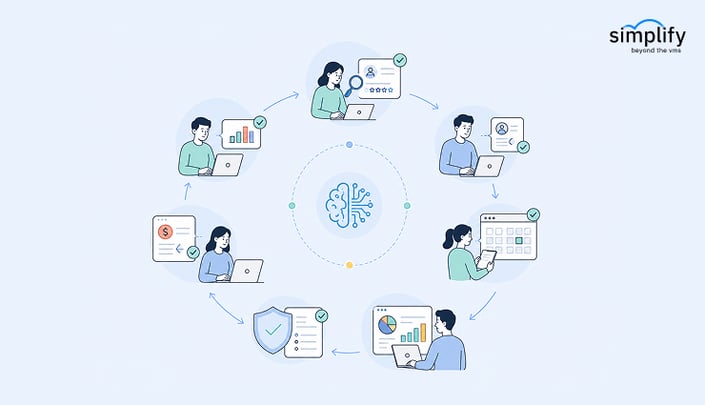
**Inside an AI-First VMS: What it Looks Like in Practice**
Most of the time, when we imagine an AI-first VMS, we think of chatbots, copilots, predictive analytics, AI-powered dashboards, and similar capabilities. However, these are features, not the defining characteristics of an AI-powered VMS.
An AI-native VMS is built differently. Intelligence is integrated into every stage of the contingent workforce lifecycle, helping organizations make better decisions instead of simply completing tasks faster.
Rather than adding AI as another capability, an [AI-first extended workforce platform](https://www.simplifyvms.com/solutions/vendor-management-system/) integrates intelligence into its core architecture, HRs, category managers, procurement professionals, external workforce, and more to work from a shared source of workforce intelligence.
As a result, organizations gain better visibility and the confidence to make better workforce decisions.
Let’s discuss a real-life business scenario to gain a detailed understanding.
## **Understanding The Contingent Workforce Lifecycle**
**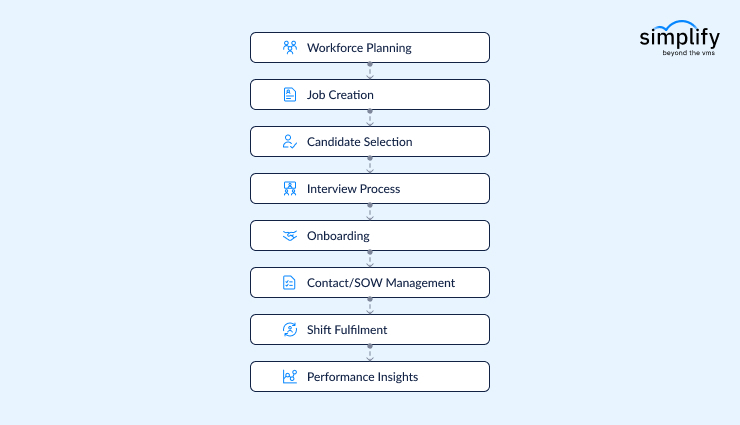**
In an AI-powered VMS, AI is integrated into every stage of the contingent workforce lifecycle, playing a crucial role in improving efficiency, accelerating processes, and saving time.
Let’s decode the role of AI from the above architecture.
### **Stage 1: Intelligence Begins Before the Requisition Exists**
Every successful contingent workforce strategy begins with effective workforce planning. Before a hiring request is created, organizations need to understand what talent they require, when they need it, and how those workforce needs align with business priorities.
In an AI-native VMS, Artificial Intelligence continuously analyzes workforce and business data to help organizations make proactive planning decisions rather than reacting to workforce shortages and market trends.
An AI-native vendor management platform evaluates multiple sources of workforce intelligence, including:
- Previous hiring patterns
- Workforce demand trends
- Skills availability
- Project pipelines
- Budget forecasts
- Internal workforce policies
- Seasonal hiring trends
- Regional workforce demand
### **Stage 2: Intelligence Makes Job Creation Easier**
Once workforce requirements have been identified, the next step is creating a job that attracts the right flexible talent.
In many organizations, hiring teams still manage these steps individually, writing job descriptions, deciding bill rates, and distributing jobs based on experience or past practices.
An AI-powered VMS simplifies and strengthens this process by using workforce intelligence to create more accurate and competitive job requests.
Instead of starting from a blank document, the platform can:
- Generate job descriptions based on the required role, skills, and previous hiring data.
- Recommend the right skills, qualifications, and experience for the position.
- Recommend appropriate bill rates based on role requirements, location, market conditions, and previous hiring trends.
- Help hiring managers create accurate and standardized job requests with less time and effort.
By analysing historical workforce data, market insights, and organizational policies, AI makes job creation faster and easier. By using AI recommendations, hiring managers receive useful recommendations that save time and help them create clear, complete, and consistent job requests.
An AI-native vendor management platform supports the job creation process with data-driven recommendations, while hiring managers remain responsible for enhancing seamless communication with the applicant, scheduling interviews, and simplifying onboarding process.
### **Stage 3: AI Helps Identify the Right Talent Faster**
Choosing the right candidate can be challenging when hundreds of resumes need to be reviewed for a single role. Hiring managers need to quickly identify candidates who have the right skills, experience, and qualifications for the role.
A VMS automates this process.
AI can support candidate selection by:
- Parsing resumes to extract relevant skills, experience, certifications, and qualifications.
- Match candidate skills based on job requirements.
- Score and rank candidates based on potential and cultural fits.
- Highlight strengths, skill gaps, and relevant experience to support faster shortlisting.
By analyzing candidate profiles against the job requirements, AI helps hiring managers identify the most suitable candidates faster, making the shortlisting process more efficient and consistent.
### **Stage 4: AI Makes Candidate Interviews More Intelligent**
Once the right candidates have been shortlisted, the next step is to evaluate them through interviews.
In many organizations, recruiters and interviewers need to prepare questions, review candidate responses, conduct multiple interview rounds, and compare feedback across candidates.
This consumes a lot of time and effort.
An AI-first VMS streamlines and automates essential aspects of the interviewing process by:
- Generating interview questions based on the role and required skills.
- Acting as a co-pilot recruiter to support L1 and L2 interviews and pre-vet candidates against job requirements.
- Scoring candidate responses based on defined role requirements.
- Analyzing behavioral patterns in interview responses to provide structured evaluation insights.
- Automate technical assessments to help evaluate relevant skills.
By bringing candidate information, interview responses, assessments, and role requirements together, AI gives recruiters a clearer view of candidate fit.
These insights help hiring teams compare candidates more consistently and make data-driven decisions.
### **Stage5:Onboarding Becomes Faster and More Seamless**
Once a candidate is selected, onboarding involves collecting required information, documents, completing background checks, and meeting compliance requirements before the worker can begin.
In many organizations, teams need to review multiple documents, verify information, track compliance requirements, and follow up on missing items. Keeping track of these requirements can slow down the onboarding process.
AI can support the onboarding process by:
- Extracting key information from submitted documents.
- Comparing information across documents to identify differences or missing details.
- Checking whether required documents are complete.
- Supporting background checks and verification processes.
- Supporting country-specific onboarding requirements.
- Tracking compliance requirements based on the worker, role, and location.
- Highlighting missing information or documents that need attention.
- Notify the right people when an action or document is still pending.
By bringing document collection, verification, background checks, and compliance requirements into one workflow, AI helps teams identify issues earlier and keep onboarding moving.
[Building a VMS with AI](https://insights.simplifyvms.com/resources/building-a-vms-with-chatgpt-vs.-buying-an-ai-powered-enterprise-vms?hsLang=en) involves much more than adding individual AI features. It means connecting intelligence across the entire workforce lifecycle.
### **Stage 6: AI Makes Contract and SOW Management More Efficient**
Once onboarding is complete, the next step is to manage the contract and SOW details that define the engagement. This can include scope, deliverables, milestones, rates, timelines, compliance requirements, and other agreed terms.
In many cases, teams need to review contracts and SOW documents, monitor budgets, track deadlines, manage time and expenses, manage approvals, identify project risks, and more.
Handling all these details across multiple documents can make it difficult to spot missing information or important changes quickly.
AI can support contract and SOW management by:
- Extracting SOW scope and deliverables to make important project details easier to review.
- Extracting key terms and information from contract and SOW documents to make them easier to review.
- Comparing SOWs and contract documents to identify differences, changes, or missing information.
- Identifying potential risks related to clauses, timelines, budgets, or other SOW requirements.
- Highlighting important terms, dates, milestones, and deliverables that need attention.
- Validating SOWs against company policies and compliance requirements.
- Monitoring SOW performance by tracking deliverables, timelines, and other project requirements.
AI automates SOW engagements and facilitates an error-free process.
### **Stage 7: Maximize Shift Fulfilment with AI**
After contracts and SOW details are in place, organizations need to make sure the right workers are available when and where they are needed. This includes managing shifts, checking worker availability, creating schedules, and filling open shifts.
Efficient shift fulfilment is important because an unfilled shift can affect daily work and put extra pressure on other workers.
For example, shift management in healthcare is important because of its nature. Emergencies come unannounced and hospitals need to be prepared to handle extra surge in patient volume at any given time.
In many cases, an organization need to manage multiple shifts, changing worker availability, scheduling needs, and manage burnouts at the same time. This is a very time-sensitive aspect of workforce management.
This is where AI can be a game-changer.
AI can be used to maximize shift fulfilment:
- Match workers with open shifts based on their skills, qualifications, availability, and shift requirements.
- Check worker availability when creating or changing schedules.
- Help manage shifts across different locations, roles, and time periods.
- AI-based recommendation to maximize shift fulfilment.
- Open shift notification and alerts for workers to accept shifts.
By combining worker availability, shift needs, skills, and scheduling information, AI helps teams fill open shifts faster, reduce scheduling gaps, and make better use of available workers.
### **Stage 8: Data-Driven Insights to Maximize Productivity**
Next up is KPI, it involves setting up and monitoring milestones.
In many cases, teams need to review performance data from different sources, compare results over time, and understand where workers are meeting expectations or falling behind.
When this information is spread across different reports and systems, it can be difficult to get a clear view of workforce performance.
AI helps in performance monitoring by:
- Creating performance scorecards to evaluate individual performance.
- Tracking worker performance against role expectations and defined goals.
- Monitoring task progress, time takes, and more.
- Compare performance over time to identify improvements or changes.
- Identify performance gaps and areas that may need attention.
- Provide useful performance insights to support better workforce decisions.
By bringing workforce performance data together, intelligence helps managers see performance more clearly, identify gaps earlier, and understand where improvements may be needed.
## **Final Thoughts**
As contingent workforce programs become more global, challenging, and complex, organizations need more than workflow automation. They need technology that helps them make better workforce decisions across the entire lifecycle.
An AI-first vendor management system is not simply traditional software with artificial intelligence added later. It brings AI, workforce data, automation, and human expertise together to support better decisions across workforce planning, job creation, candidate selection, onboarding, [contracts and SOW management](https://www.simplifyvms.com/solutions/services-procurement/), shift fulfilment, and workforce performance.
For enterprise leaders, the question is no longer:
*“Does our VMS include AI?”*
*The more important question is:*
*“Is intelligence built into the workforce lifecycle, or is AI simply another feature added to existing workflows?”*
The answer will shape how effectively organizations manage their workforce, reduce risks, improve efficiency, and make better decisions across the external workforce lifecycle.
We hope this guide helped you understand what makes a VMS truly AI-first and how AI can improve workforce management across the entire lifecycle. Explore these related articles for more insights on VMS, AI, SOW management, and workforce optimization:
[How SOW Management Brings Structure and Visibility to Services Procurement?](https://insights.simplifyvms.com/resources/how-does-sow-management-bring-structure-to-services-procurement?hsLang=en)
[How AI Helps Healthcare CFOs Improve Workforce Management?](https://www.healthcarevms.com/articles/healthcare-cfos-guide-to-smarter-workforce-management-with-ai/)
[Vendor Management Strategy: Apply Globally or Locally](https://insights.simplifyvms.com/resources/vendor-management-strategy-implement-globally-or-locally?hsLang=en)
[Vendor Management](https://insights.simplifyvms.com/resources/tag/vendor-management)

#### Arun Kumar
AI & SaaS Content Specialist, SimplifyVMS
A content professional with 7+ years of experience focused on SaaS, AI, automation, digital transformation, and emerging technology trends. Passionate about reading and writing technology and SaaS-focused content that helps businesses understand complex technology, explore industry trends, and address real-world challenges. Particularly interested in how AI and technology are shaping the future of the contingent workforce industry.
#### Don't forget to share this Post
##### Your comments
#### Subscribe Now
Discover the latest industry trends on flexible workforce and free tips and hacks to enhance vendor performance.
##### Connect With Us
###### Blog Topics
- [Vendor Management](https://insights.simplifyvms.com/resources/tag/vendor-management)
- [Service Procurement](https://insights.simplifyvms.com/resources/tag/service-procurement)
- [Recruitment](https://insights.simplifyvms.com/resources/tag/recruitment)
- [Healthcare](https://insights.simplifyvms.com/resources/tag/healthcare)
###### Popular Posts
## Read On
[](https://insights.simplifyvms.com/resources/will-your-company-exist-3-years-from-now-without-an-external-workforce?hsLang=en)
### [Will Your Company Exist 3 Years From Now Without An External Workforce?](https://insights.simplifyvms.com/resources/will-your-company-exist-3-years-from-now-without-an-external-workforce?hsLang=en)
###### The external workforce will be an essential part of any company three years from now. Without...
[](https://insights.simplifyvms.com/resources/what-it-takes-to-win-your-cto-over-on-a-vms?hsLang=en)
### [What It Takes to Win Your CTO Over on a VMS?](https://insights.simplifyvms.com/resources/what-it-takes-to-win-your-cto-over-on-a-vms?hsLang=en)
For years, Vendor Management Systems (VMS) have been largely viewed as procurement tools.
[-1.jpg?width=352&name=image%20(7)-1.jpg)](https://insights.simplifyvms.com/resources/top-50-leadership-interview-questions-to-ask-candidates?hsLang=en)
### [Top 50 Leadership Interview Questions to Ask Candidates](https://insights.simplifyvms.com/resources/top-50-leadership-interview-questions-to-ask-candidates?hsLang=en)
Hiring the right leader is one of the most critical decisions an organization can make.
[](https://www.simplifyvms.com/)
We provide flexible technology solutions to build and manage a workforce ecosystem that can adapt to changing needs and demands. We empower clients with the tools and resources needed to thrive in today’s ever-changing business landscape
##### Company
- [Our Vision](https://www.simplifyvms.com/company/about/#about)
- [Our Mission](https://www.simplifyvms.com/company/about/#mission)
- [Our Values](https://www.simplifyvms.com/company/about/#core-values)
- [Leadership Team](https://www.simplifyvms.com/company/about/#leadership)
- [Get in Touch](https://www.simplifyvms.com/company/get-in-touch/)
##### Information
- [Request A Demo](https://www.simplifyvms.com/demo/)
- [Careers](https://www.simplifyvms.com/company/careers/)
- [Case Studies](https://insights.simplifyvms.com/)
- [Webinar](https://www.simplifyvms.com/resources/webinar/)
- [Privacy Policy](https://www.simplifyvms.com/privacy-policy/)
##### Our Locations
- [USA - Headquarters](https://www.simplifyvms.com/company/our-locations/#usa)
- [India](https://www.simplifyvms.com/company/our-locations/#india)
- [Europe](https://www.simplifyvms.com/company/our-locations/#europe)
- [Canada](https://www.simplifyvms.com/company/our-locations/#canada)
- [Accessibility Statement](https://www.simplifyvms.com/accessibility-statement)
- [Trust Center](https://www.simplifyvms.com/trust-center)
- [Modern Slavery Act Statement](https://www.simplifyvms.com/modern-slavery-policy)
- [Supplier Code of Conduct](https://www.simplifyvms.com/human-rights/)
- [Privacy Policy](https://www.simplifyvms.com/privacy-policy)
- [Copyright Policy](https://www.simplifyvms.com/copy-right)
©2026 Simplify. All rights reserved.
```json
{
"@context" : "https://schema.org",
"@type" : "BlogPosting",
"author" : {
"@type" : "Person",
"name" : "Arun Kumar - AI & SaaS Content Specialist, SimplifyVMS",
"url" : "https://insights.simplifyvms.com/resources/author/arun-kumar-ai-saas-content-specialist"
},
"dateModified" : "2026-10-08T06:49:12.181Z",
"datePublished" : "2026-08-21T13:36:49.000Z",
"headline" : "What Does an AI-First VMS Actually Look Like? A Walk Through the Contingent Workforce Lifecycle",
"image" : [ "https://insights.simplifyvms.com/hubfs/Inside%20an%20AI-First%20VMS%20The%20Contingent%20Workforce%20Lifecycle%20-%20SimplifyVMS.jpg" ],
"mainEntityOfPage" : {
"@id" : "https://insights.simplifyvms.com/resources/what-does-an-ai-first-vms-actually-look-like-a-walk-through-the-contingent-workforce-lifecycle",
"@type" : "WebPage"
},
"publisher" : {
"@type" : "Organization",
"logo" : {
"@type" : "ImageObject"
},
"name" : "Simplify Workforce"
}
}
```