---
title: 11 Signs You've Outgrown Spreadsheets in Services Procurement
description: Still managing services procurement with spreadsheets? Discover 11 signs it's time to upgrade to procurement software for better visibility & compliance.
image: https://insights.simplifyvms.com/hubfs/11%20Signs%20Youve%20Outgrown%20Spreadsheets%20in%20Service%20Procurement.jpg
---
SimplifyVMS Recognized as a Global Leader and Star Performer in Everest Group’s 2026 PEAK Matrix® Assessment for Vendor Management Systems (VMS)

[Skip to content](https://insights.simplifyvms.com/resources/11-signs-youve-outgrown-spreadsheets-in-services-procurement#main-content)
[](https://www.simplifyvms.com/)
- Why Simplify?
Show submenu for Why Simplify?
- [Simplify Your Complexity](https://www.simplifyvms.com/#simplify-your-complexity)
- [Our Technology Difference](https://www.simplifyvms.com/#our-technology-difference)
- [How We Are Different](https://www.simplifyvms.com/#how-we-are-different)
- [What Customers Are Saying](https://www.simplifyvms.com/#testimonials)
- Solutions
Show submenu for Solutions

- Flexible Workforce Solutions
Show submenu for Flexible Workforce Solutions
- [Vendor Management System (VMS)](https://www.simplifyvms.com/solutions/vendor-management-system/)
- [Direct Sourcing And Talent Pools](https://www.simplifyvms.com/solutions/directsourcing/)
- [Services Procurement](https://www.simplifyvms.com/solutions/services-procurement/)
- [Healthcare Credentialing](https://www.simplifyvms.com/solutions/credentialing/)
- [Artificial Intelligence Suite](https://www.simplifyvms.com/solutions/artificial-intelligence-suite/)
- [Neurodiverse Talent Solutions](https://www.simplifyvms.com/solutions/neurodiverse-talent-sourcing/)
- Integrations
Show submenu for Integrations
- [Integration Platform](https://www.simplifyvms.com/solutions/integration-platform/)
- [Partnerships](https://www.simplifyvms.com/partnerships/)
- Resources
Show submenu for Resources

- Blogs
Show submenu for Blogs
- [Insights](https://insights.simplifyvms.com/resources)
- [Recruitment](https://insights.simplifyvms.com/resources/tag/recruitment)
- [Vendor Management](https://insights.simplifyvms.com/resources/tag/vendor-management)
- [Service Procurement](https://insights.simplifyvms.com/resources/tag/service-procurement)
- Knowledge Hub
Show submenu for Knowledge Hub
- [Guides for Vendors](https://insights.simplifyvms.com/guides-for-vendors?hsLang=en)
- [Guides for Business](https://insights.simplifyvms.com/guides-for-business?hsLang=en)
- [Whitepapers](https://insights.simplifyvms.com/white-papers?hsLang=en)
- Client Stories
Show submenu for Client Stories
- [Case Studies](https://insights.simplifyvms.com/?hsLang=en)
- Community & Events
Show submenu for Community & Events
- [Customer Advisory Board](https://www.simplifyvms.com/resources/customer-advisory-board/)
- [Events](https://www.simplifyvms.com/resources/events/)
- [Simplify Talks](https://www.simplifyvms.com/resources/simplify-talks/)
- Standard Agreement
Show submenu for Standard Agreement
- [Mutual NDA](https://www.simplifyvms.com/resources/mutualnda/)
- [Data Protection Addendum](https://www.simplifyvms.com/simplifyworkforce-data-protection-addendum.pdf)
- Company
Show submenu for Company

- About
Show submenu for About
- [Our Vision](https://www.simplifyvms.com/company/about/#vision)
- [Our Mission](https://www.simplifyvms.com/company/about/#mission)
- [Our Values](https://www.simplifyvms.com/company/about/#core-values)
- [Leadership Team](https://www.simplifyvms.com/company/about/#leadership)
- [Get In Touch](https://www.simplifyvms.com/company/get-in-touch/)
- Life @Simplify
Show submenu for Life @Simplify
- [Careers](https://www.simplifyvms.com/company/careers/)
- Why Simplify?
Show submenu for Why Simplify?
- [Simplify Your Complexity](https://www.simplifyvms.com/#simplify-your-complexity)
- [Our Technology Difference](https://www.simplifyvms.com/#our-technology-difference)
- [How We Are Different](https://www.simplifyvms.com/#how-we-are-different)
- [What Customers Are Saying](https://www.simplifyvms.com/#testimonials)
- Solutions
Show submenu for Solutions

- Flexible Workforce Solutions
Show submenu for Flexible Workforce Solutions
- [Vendor Management System (VMS)](https://www.simplifyvms.com/solutions/vendor-management-system/)
- [Direct Sourcing And Talent Pools](https://www.simplifyvms.com/solutions/directsourcing/)
- [Services Procurement](https://www.simplifyvms.com/solutions/services-procurement/)
- [Healthcare Credentialing](https://www.simplifyvms.com/solutions/credentialing/)
- [Artificial Intelligence Suite](https://www.simplifyvms.com/solutions/artificial-intelligence-suite/)
- [Neurodiverse Talent Solutions](https://www.simplifyvms.com/solutions/neurodiverse-talent-sourcing/)
- Integrations
Show submenu for Integrations
- [Integration Platform](https://www.simplifyvms.com/solutions/integration-platform/)
- [Partnerships](https://www.simplifyvms.com/partnerships/)
- Resources
Show submenu for Resources

- Blogs
Show submenu for Blogs
- [Insights](https://insights.simplifyvms.com/resources)
- [Recruitment](https://insights.simplifyvms.com/resources/tag/recruitment)
- [Vendor Management](https://insights.simplifyvms.com/resources/tag/vendor-management)
- [Service Procurement](https://insights.simplifyvms.com/resources/tag/service-procurement)
- Knowledge Hub
Show submenu for Knowledge Hub
- [Guides for Vendors](https://insights.simplifyvms.com/guides-for-vendors?hsLang=en)
- [Guides for Business](https://insights.simplifyvms.com/guides-for-business?hsLang=en)
- [Whitepapers](https://insights.simplifyvms.com/white-papers?hsLang=en)
- Client Stories
Show submenu for Client Stories
- [Case Studies](https://insights.simplifyvms.com/?hsLang=en)
- Community & Events
Show submenu for Community & Events
- [Customer Advisory Board](https://www.simplifyvms.com/resources/customer-advisory-board/)
- [Events](https://www.simplifyvms.com/resources/events/)
- [Simplify Talks](https://www.simplifyvms.com/resources/simplify-talks/)
- Standard Agreement
Show submenu for Standard Agreement
- [Mutual NDA](https://www.simplifyvms.com/resources/mutualnda/)
- [Data Protection Addendum](https://www.simplifyvms.com/simplifyworkforce-data-protection-addendum.pdf)
- Company
Show submenu for Company

- About
Show submenu for About
- [Our Vision](https://www.simplifyvms.com/company/about/#vision)
- [Our Mission](https://www.simplifyvms.com/company/about/#mission)
- [Our Values](https://www.simplifyvms.com/company/about/#core-values)
- [Leadership Team](https://www.simplifyvms.com/company/about/#leadership)
- [Get In Touch](https://www.simplifyvms.com/company/get-in-touch/)
- Life @Simplify
Show submenu for Life @Simplify
- [Careers](https://www.simplifyvms.com/company/careers/)
[Request A Demo](https://www.simplifyvms.com/demo/)
# 11 Signs You've Outgrown Spreadsheets in Services Procurement | Resources
*by* [Arun Kumar - AI & SaaS Content Specialist, SimplifyVMS](https://insights.simplifyvms.com/resources/author/arun-kumar-ai-saas-content-specialist)
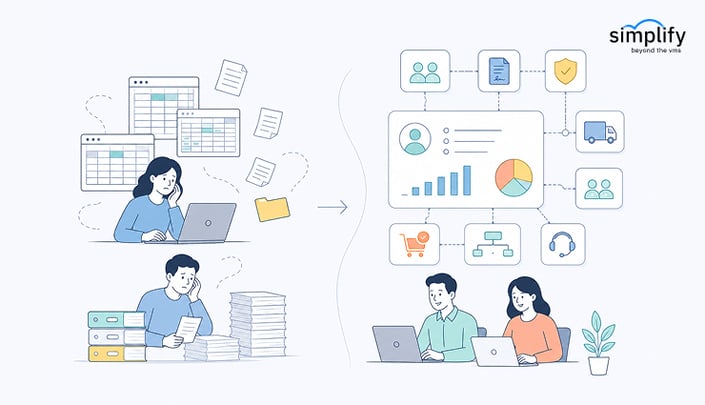
As organizations expand their contingent workforce programs, supplier networks, and services spend, procurement processes naturally become more complex. What once worked in a spreadsheet for a small team may no longer provide the visibility, control, and automation required to support a growing business.
This doesn't mean spreadsheets are ineffective. In fact, they often serve organizations well during the early stages of procurement management. However, there comes a point when increasing volumes, compliance requirements, and stakeholder expectations demand a more sophisticated approach.
If any of the following signs sound familiar, it may be time to consider dedicated services procurement software like [SimplifyVMS](https://www.simplifyvms.com/)that can streamline operations, automate workflows, and improve overall visibility.
## Why Growing Organizations Move Beyond Spreadsheets?
Spreadsheets are excellent tools for organizing data, but they were not designed to manage enterprise procurement workflows, supplier relationships, approvals, contracts, and spend management at scale.
The conversation around **spreadsheets vs procurement software** isn't about replacing spreadsheets entirely, it's about recognizing when your procurement program has grown beyond their capabilities.
Here are 11 signs your organization may have reached that stage.
## 1. Approval Requests Involve Multiple Stakeholders
As procurement programs mature, approvals often require input from procurement, finance, HR, legal, and operational leaders.
Signs of growth include:
- Multiple approval levels
- Department-specific authorization requirements
- Budget validation steps
- Cross-functional review processes
Modern **procurement workflow approval** systems automate routing and notifications, ensuring requests move efficiently through the organization.
## 2. Procurement Data Is Spread Across Multiple Teams
As more departments engage suppliers and services providers, procurement information often expands beyond a single spreadsheet.
You may notice:
- Multiple tracking files
- Department-specific reports
- Separate supplier databases
- Increased collaboration requirements
- Consistent onboarding processes
- Qualification tracking
- Contract visibility
- Performance monitoring
Services procurement software provides a centralized environment where all stakeholders work from the same source of information.
## 3. Your Supplier Network Continues to Expand
Growth often brings new suppliers, consultants, staffing partners, and service providers.
Managing a larger supplier ecosystem requires:
- Consistent onboarding processes
- Qualification tracking
- Contract visibility
- Performance monitoring
Dedicated **supplier management** capabilities help organizations maintain stronger supplier relationships while reducing administrative effort.
## 4. Leadership Requires Greater Spend Visibility
As services spending increases, executives naturally seek more detailed insights into procurement activity.
Common requests include:
- Department-level spending
- Supplier spend analysis
- Budget forecasting
- Workforce cost visibility
Advanced **spend management** tools provide real-time reporting and analytics that support informed decision-making.
## 5. Compliance Requirements Are Becoming More Complex
Growing organizations often face increasing regulatory, contractual, and internal compliance obligations.
Examples include:
- Supplier certifications
- Worker classification requirements
- Audit documentation
- Approval records
Services procurement software helps maintain accurate records and consistent compliance processes across the organization.
## 6. You're Managing More Contracts Than Ever Before
As procurement activity expands, contract portfolios become larger and more difficult to monitor manually.
Organizations often need visibility into:
- Contract start and end dates
- Renewal schedules
- Service-level agreements
- Supplier obligations
- Automated invoice matching
Automated contract tracking helps ensure important milestones never go unnoticed.
## 7. Invoice Volumes Are Increasing
A growing supplier base naturally results in more invoices, purchase orders, and payment workflows.
As transaction volumes rise, organizations benefit from:
- Automated invoice matching
- Streamlined approvals
- Faster processing cycles
- Improved payment accuracy
Automation reduces administrative effort while improving financial controls.
## 8. Stakeholders Need More Detailed Reporting
Today's procurement leaders are expected to provide strategic insights, not just transaction data.
Reporting requirements often include:
- Supplier performance metrics
- Spend trends
- Project-level costs
- Workforce analytics
Services procurement software enables real-time reporting without requiring manual spreadsheet consolidation.
## 9. Teams Need Greater Process Standardization
As procurement activities expand across departments and regions, consistency becomes increasingly important.
Organizations often seek:
- Standardized workflows
- Consistent approval processes
- Uniform supplier onboarding
- Shared procurement policies
**Procurement process automation** helps create repeatable processes while allowing flexibility where needed.
## 10. Supplier Performance Has Become a Strategic Priority
Leading organizations increasingly view suppliers as strategic busine ss partners rather than transactional vendors.
This requires visibility into:
- Service quality
- Delivery performance
- Cost efficiency
- Contract compliance
Advanced supplier management tools make it easier to evaluate and improve supplier performance over time.
## 11. Executives Expect Real-Time Procurement Insights
Modern business leaders want instant access to procurement data and operational metrics.
Common questions include:
- How much services spend is under management?
- Which suppliers deliver the best value?
- Where are approval bottlenecks occurring?
- What trends are impacting procurement costs?
Services procurement software delivers the visibility and analytics needed to answer these questions confidently.
## The Benefits of Procurement Process Automation
Organizations that adopt **procurement process automation** often gain:
- Faster approvals
- Improved supplier collaboration
- Greater spend visibility
- Enhanced compliance oversight
- Reduced administrative workload
- Better business decision-making
Most importantly, automation allows procurement teams to focus on strategic initiatives instead of managing manual processes.
## Final Thoughts
Outgrowing spreadsheets is often a sign of organizational success. It reflects increasing procurement maturity, growing supplier ecosystems, expanding workforce programs, and rising expectations for visibility and control.
If your organization is experiencing these growth indicators, it may be time to evaluate [**services procurement software**](https://www.simplifyvms.com/solutions/services-procurement/) that can support the next stage of your procurement journey.
With the right technology in place, procurement and HR leaders can automate workflows, strengthen supplier management, improve spend management, and build a more scalable procurement operation for the future.
That’s a wrap for today.
We hope you find this guide insightful. You might want to check out the following resourceful guides:
- [How to Choose the Right SOW and Contractor Management Software in 2026](https://insights.simplifyvms.com/resources/how-to-choose-sow-and-contractor-software?hsLang=en)
- [What It Takes to Convince Your CTO to Invest in a VMS?](https://insights.simplifyvms.com/resources/what-it-takes-to-win-your-cto-over-on-a-vms?hsLang=en)
- [A Complete Guide to SOW Management in Services Procurement](https://insights.simplifyvms.com/resources/how-does-sow-management-bring-structure-to-services-procurement?hsLang=en)
[Service Procurement](https://insights.simplifyvms.com/resources/tag/service-procurement)

#### Arun Kumar
AI & SaaS Content Specialist, SimplifyVMS
A content professional with 7+ years of experience focused on SaaS, AI, automation, digital transformation, and emerging technology trends. Passionate about reading and writing technology and SaaS-focused content that helps businesses understand complex technology, explore industry trends, and address real-world challenges. Particularly interested in how AI and technology are shaping the future of the contingent workforce industry.
#### Don't forget to share this Post
##### Your comments
#### Subscribe Now
Discover the latest industry trends on flexible workforce and free tips and hacks to enhance vendor performance.
##### Connect With Us
###### Blog Topics
- [Vendor Management](https://insights.simplifyvms.com/resources/tag/vendor-management)
- [Service Procurement](https://insights.simplifyvms.com/resources/tag/service-procurement)
- [Recruitment](https://insights.simplifyvms.com/resources/tag/recruitment)
- [Healthcare](https://insights.simplifyvms.com/resources/tag/healthcare)
###### Popular Posts
## Read On
[.jpg?width=352&name=How%20to%20Manage%20Services%20Procurement%20Effectively-06-06%20(1).jpg)](https://insights.simplifyvms.com/resources/how-to-manage-services-procurement-effectively?hsLang=en)
### [How to Manage Services Procurement Effectively?](https://insights.simplifyvms.com/resources/how-to-manage-services-procurement-effectively?hsLang=en)
Services procurement has become a strategic priority for organizations seeking flexibility,...
[.jpg?width=352&name=blog%20cover-07%20(1).jpg)](https://insights.simplifyvms.com/resources/services-procurement-gaining-control-and-visibility-over-sow-spend?hsLang=en)
### [Services Procurement: Gaining Control and Visibility over SOW Spend](https://insights.simplifyvms.com/resources/services-procurement-gaining-control-and-visibility-over-sow-spend?hsLang=en)
Organizations spend a significant amount every year on projects delivered through Statement of Work...
[.jfif)](https://insights.simplifyvms.com/resources/top-7-strategies-for-effective-it-procurement-services-negotiation?hsLang=en)
### [Top 7 Strategies for Effective IT Procurement Services Negotiation](https://insights.simplifyvms.com/resources/top-7-strategies-for-effective-it-procurement-services-negotiation?hsLang=en)
The procurement of IT services plays an important role in driving organizational growth and...
[](https://www.simplifyvms.com/)
We provide flexible technology solutions to build and manage a workforce ecosystem that can adapt to changing needs and demands. We empower clients with the tools and resources needed to thrive in today’s ever-changing business landscape
##### Company
- [Our Vision](https://www.simplifyvms.com/company/about/#about)
- [Our Mission](https://www.simplifyvms.com/company/about/#mission)
- [Our Values](https://www.simplifyvms.com/company/about/#core-values)
- [Leadership Team](https://www.simplifyvms.com/company/about/#leadership)
- [Get in Touch](https://www.simplifyvms.com/company/get-in-touch/)
##### Information
- [Request A Demo](https://www.simplifyvms.com/demo/)
- [Careers](https://www.simplifyvms.com/company/careers/)
- [Case Studies](https://insights.simplifyvms.com/)
- [Webinar](https://www.simplifyvms.com/resources/webinar/)
- [Privacy Policy](https://www.simplifyvms.com/privacy-policy/)
##### Our Locations
- [USA - Headquarters](https://www.simplifyvms.com/company/our-locations/#usa)
- [India](https://www.simplifyvms.com/company/our-locations/#india)
- [Europe](https://www.simplifyvms.com/company/our-locations/#europe)
- [Canada](https://www.simplifyvms.com/company/our-locations/#canada)
- [Accessibility Statement](https://www.simplifyvms.com/accessibility-statement)
- [Trust Center](https://www.simplifyvms.com/trust-center)
- [Modern Slavery Act Statement](https://www.simplifyvms.com/modern-slavery-policy)
- [Supplier Code of Conduct](https://www.simplifyvms.com/human-rights/)
- [Privacy Policy](https://www.simplifyvms.com/privacy-policy)
- [Copyright Policy](https://www.simplifyvms.com/copy-right)
©2026 Simplify. All rights reserved.
```json
{
"@context" : "https://schema.org",
"@type" : "BlogPosting",
"author" : {
"@type" : "Person",
"name" : "Arun Kumar - AI & SaaS Content Specialist, SimplifyVMS",
"url" : "https://insights.simplifyvms.com/resources/author/arun-kumar-ai-saas-content-specialist"
},
"dateModified" : "2026-09-30T11:25:39.325Z",
"datePublished" : "2026-06-04T07:36:47.000Z",
"headline" : "11 Signs You've Outgrown Spreadsheets in Services Procurement",
"image" : [ "https://insights.simplifyvms.com/hubfs/11%20Signs%20Youve%20Outgrown%20Spreadsheets%20in%20Service%20Procurement.jpg" ],
"mainEntityOfPage" : {
"@id" : "https://insights.simplifyvms.com/resources/11-signs-youve-outgrown-spreadsheets-in-services-procurement",
"@type" : "WebPage"
},
"publisher" : {
"@type" : "Organization",
"logo" : {
"@type" : "ImageObject"
},
"name" : "Simplify Workforce"
}
}
```